The Age of Compute: Why GPU Infrastructure Is Becoming a Strategic Asset
AI growth depends on physical compute. Explore why GPU fleets, data-center demand and reinvestment are turning productive compute infrastructure into a strategic asset.
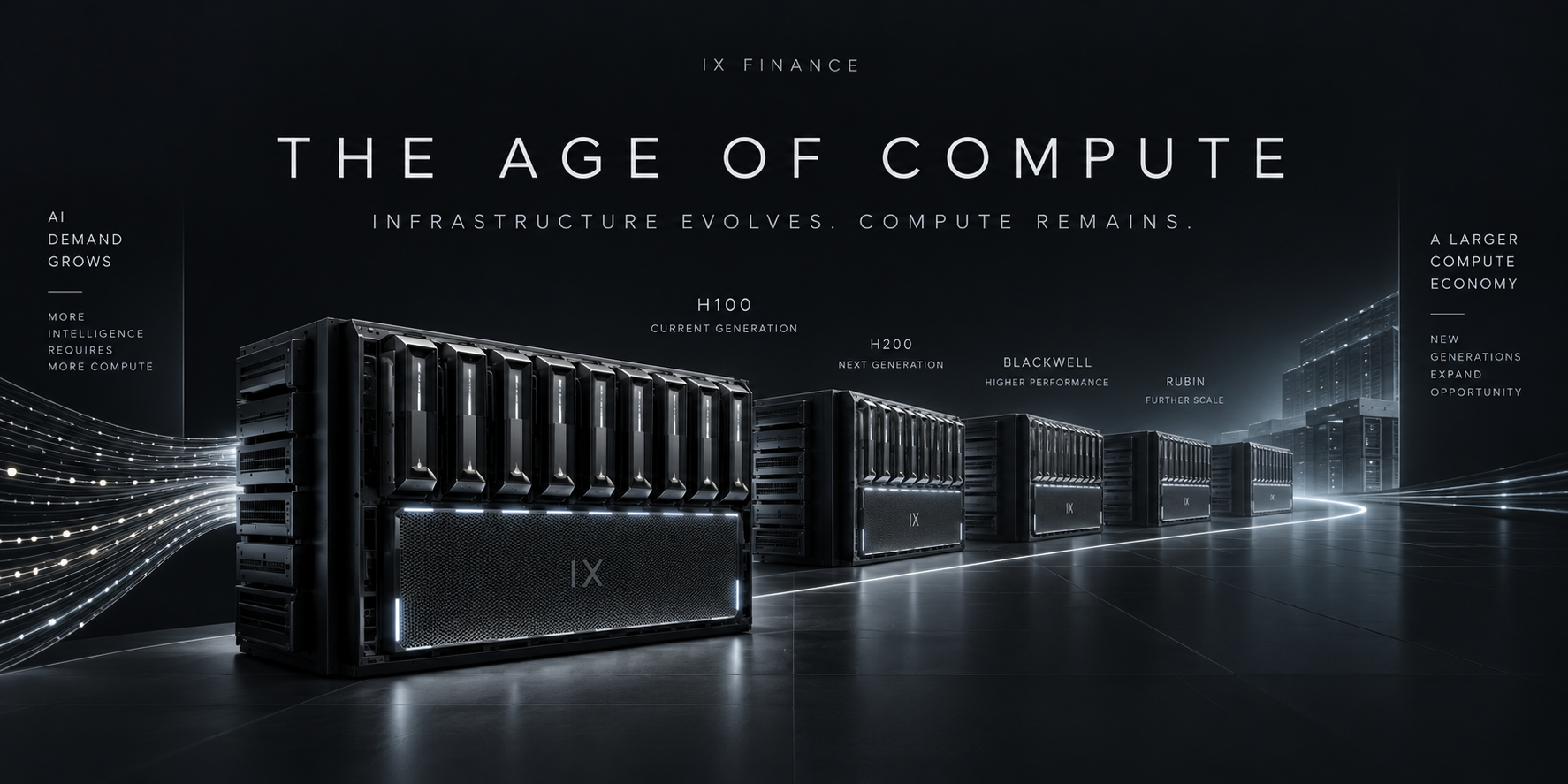
For most of the industrial age, oil sat underneath almost everything.
Transportation needed it. Manufacturing needed it. Global trade needed it. Entire economies were built around access to energy.
AI has a different input.
Compute.
The comparison isn't perfect. Oil is extracted and burned. Compute is manufactured, upgraded and becomes more efficient with every generation.
But the economic logic is starting to rhyme.
If you want to train an AI model, you need compute.
If you want to run that model for millions of users, you need more compute.
If you want autonomous vehicles, AI agents, robotics, drug discovery, video generation or increasingly capable software, all of that intelligence eventually has to run somewhere.
Software may look weightless.
Compute isn't.
Behind every AI request sits physical infrastructure doing the work.
And we're going to need a lot more of it.
Key takeaways
- AI's growth increasingly depends on physical compute infrastructure, not software alone.
- Data-center investment, electricity demand and GPU revenue all point toward rapidly expanding compute demand.
- The long-term thesis is not a specific GPU generation, but the ability to own, operate and renew productive compute capacity.
- Productive GPU infrastructure can generate revenue, reinvest in newer capacity and potentially broaden ownership through tokenization.
The numbers are getting difficult to ignore
McKinsey estimates that data centers could require roughly $6.7 trillion in global investment by 2030.
About $5.2 trillion of that would be needed for infrastructure supporting AI workloads alone.
Put differently, this isn't only a software boom.
It's one of the largest infrastructure build-outs happening anywhere in the world.
Another McKinsey analysis estimates global data-center demand could rise from roughly 82 GW in 2025 to around 220 GW by 2030 under current adoption scenarios.
Almost triple in five years.
The energy system is seeing the same thing from another angle.
The International Energy Agency expects electricity consumption from data centers to rise from around 485 TWh in 2025 to roughly 950 TWh by 2030. More importantly, electricity consumption from AI-focused data centers is projected to roughly triple over that period.
These are enormous numbers.
But perhaps the clearest signal is sitting in front of us already.
NVIDIA reported $89 billion in Data Center revenue in its latest quarter, up 117% from a year earlier.
One quarter.
Companies aren't spending that kind of money because GPUs make a good narrative.
They're building capacity because somebody needs the compute.
Today's H100 is not the thesis
This distinction matters.
Right now, H100s are among the machines powering the AI economy.
Five years from now, they won't be the newest GPUs.
That's fine.
A logistics business isn't based on believing one model of truck will remain the best truck forever.
An airline doesn't build its business around one generation of aircraft.
Infrastructure evolves.
Fleets get upgraded.
Older equipment is replaced when better economics become available.
The same logic applies to compute.
Today a fleet might contain H100s.
Then H200s.
Then Blackwell.
Then Rubin.
And eventually hardware we haven't seen yet.
| Hardware generation | Role in the thesis |
|---|---|
| H100 | Current productive capacity |
| H200 | Newer generation |
| Blackwell | Higher-performance replacement/expansion |
| Rubin | Next infrastructure cycle |
| Future accelerators | Continued fleet renewal |
| Constant | Demand for computation |
The long-term asset isn't really the H100.
It's the capacity to own, operate and continually renew productive compute infrastructure.
That's a very different thesis.
Better GPUs don't necessarily reduce the need for GPUs
There's an intuitive argument that comes up whenever hardware becomes more efficient.
If tomorrow's GPUs are dramatically more powerful, surely we'll need fewer of them.
History tends to make this more complicated.
When computing becomes cheaper or more capable, people usually find new things to do with it.
We didn't build faster internet and decide we'd finally downloaded enough data.
We didn't make smartphones more powerful and then stop using mobile computing.
More capability created more applications.
AI appears to be following a similar path.
Better models enable better products.
Better products attract more users.
More users generate more inference.
And new capabilities create workloads that previously weren't practical at all.
The IEA already points to reasoning models, video generation and agentic systems as examples of workloads that can require dramatically more energy per task than simple text generation.
Efficiency improves.
Demand expands with it.
Both can be true at the same time.
Training was only the beginning
The first phase of the AI boom made model training famous.
Huge clusters of GPUs running for weeks or months to create increasingly capable foundation models.
But a trained model isn't particularly useful if nobody runs it.
That's inference.
Every time an AI application responds to someone, analyzes something, creates an image, generates video, controls a robot or makes a decision, compute is being consumed again.
And again.
And again.
McKinsey expects inference to surpass training as the dominant AI workload by 2030, accounting for more than half of AI compute and roughly 30–40% of overall data-center demand.
That's an important transition.
Training creates periodic bursts of enormous compute demand.
Inference can become recurring demand tied to the everyday use of AI products.
Imagine hundreds of millions of people using AI occasionally.
Now imagine billions of people using agents constantly.
Businesses running models inside normal workflows.
Factories using machine vision.
Cars making real-time decisions.
Robots interpreting the physical world.
Personal AI systems running continuously rather than waiting for someone to type a prompt.
Nobody knows exactly how large that market becomes.
But the direction is difficult to miss.
AI is moving from something we try to something that increasingly runs.
And running requires compute.
That's what makes GPUs productive assets
There's another part of this story that interests us at IX.
A GPU isn't valuable simply because it is scarce hardware.
It can perform work that somebody is willing to pay for.
A company needs compute.
It rents capacity.
The machine processes the workload.
Revenue is generated.
That's a remarkably understandable economic loop.
Capital buys productive infrastructure.
Productive infrastructure provides compute.
Customers pay to use that compute.
Of course, every infrastructure business still has costs. Electricity, hosting, cooling, maintenance and hardware renewal don't disappear.
But that's true of productive assets everywhere.
A building requires maintenance.
A power plant requires fuel and operations.
A logistics fleet requires vehicles, drivers and repairs.
What makes them productive isn't the absence of cost.
It's the existence of demand for what they produce.
GPUs produce computation.
And computation is rapidly becoming an input to an enormous part of the economy.
The next GPU can be bought by the previous one
This is where the model gets particularly interesting.
Suppose productive infrastructure generates cash flow.
There are two basic things an owner can do with it.
Take the money out.
Or reinvest some of it.
Reinvestment changes the story.
A fleet of GPUs generates rental revenue.
Part of that revenue can be used to acquire additional or newer compute capacity.
That increases the productive base.
A larger or more capable fleet can potentially serve more workloads.
That creates the possibility of more revenue.
And some of that can be reinvested again.
This isn't magic compounding.
The compounding mechanism is operational, not magical.
Productive infrastructure generates revenue. Part of that revenue can be reinvested into newer or additional compute capacity, expanding the productive base.
Hardware still has a price. Demand still matters. Operations still matter.
But the underlying principle is familiar from almost every capital-intensive industry:
productive assets can help finance the growth of the asset base itself.
A company buys one factory.
The factory produces.
Profits help fund factory number two.
Compute infrastructure can follow the same logic.
The difference is that the machines themselves may improve dramatically between investment cycles.
The next dollar doesn't necessarily buy another H100.
It could buy a GPU with far more useful compute per watt, more memory, faster networking and better economics.
That is why looking at the current fleet alone misses part of the opportunity.
A five-year view looks very different
Imagine looking at an AI infrastructure portfolio in 2031.
It would be strange to judge it based on whether the H100 remained the world's most powerful GPU.
Of course it won't.
The better question is:
Did the infrastructure owner keep converting yesterday's revenue into tomorrow's compute?
A well-run compute fleet can evolve.
H100s today.
Newer architectures tomorrow.
Different machines optimized for different workloads.
Perhaps entirely new types of accelerators as the market changes.
What remains constant is the thing customers are buying:
computation.
This is why we think of compute capacity more like infrastructure than consumer technology.
The individual machine has a lifecycle.
The demand it serves can outlive many generations of hardware.
Who gets to own the AI economy underneath the AI economy?
There's another question worth asking.
We talk constantly about the companies building AI products.
OpenAI.
Google.
Anthropic.
Meta.
The next generation of AI startups.
But beneath that application layer is another economy.
Someone owns the chips.
Someone owns the servers.
Someone owns the data centers.
Someone supplies the electricity.
Someone owns the infrastructure being rented every time another company needs more capacity.
Historically, access to this layer has required serious capital.
A single high-end GPU server is expensive. A meaningful fleet is much more expensive. Then comes hosting, power and operations.
That's partly why hyperscalers became hyperscalers.
Scale matters.
But financial infrastructure is changing too.
Fractional ownership and tokenization create the possibility of separating the size of an infrastructure asset from the size of the investment required to participate in it.
That doesn't change whether the hardware is productive.
It changes who can own the productive asset.
And that, to us, is one of the more interesting intersections between AI and real-world assets.
Compute may become one of this era's strategic resources
Calling compute “the new oil” is inevitably an imperfect metaphor.
Compute isn't finite in the same way.
We can manufacture more.
Hardware gets better.
Algorithms get more efficient.
And unlike a barrel of oil, a GPU can perform productive work repeatedly over its useful life.
But the comparison captures something important.
Oil became strategically important because enormous parts of the economy couldn't function without energy.
AI makes computation increasingly similar.
As intelligence moves into software, software needs somewhere to think.
That requires chips.
Power.
Cooling.
Networking.
Data centers.
And increasingly large amounts of all of them.
By 2030, today's numbers may look surprisingly small.
Or AI adoption may develop differently than current forecasts suggest. Forecasts aren't promises.
But we're already watching hundreds of billions of dollars flow into the infrastructure layer, and the industry's own capacity requirements continue moving upward.
The AI revolution isn't happening somewhere in “the cloud.”
It's happening inside physical machines.
They can be operated.
They can generate revenue.
And when technology moves forward, the infrastructure around them can move forward too.
H100 is a generation.
Compute is the asset class.
Keep reading
All posts →Tokenized GPU Ownership: The Next Trillion-Dollar Asset Class
Physical GPUs are becoming income-generating assets on-chain. Here's why tokenized GPU ownership is the most overlooked crypto investment opportunity.
How to Invest in AI Infrastructure: A Guide to Tokenized GPU Compute
AI runs on physical GPUs, clusters and data centers — but owning that infrastructure has always needed institutional capital. Here's how tokenized compute lets anyone invest in AI infrastructure and earn from real workloads.
The register is live.
IX-CORE is the first book on it, running on Base testnet and settling in test tokens. Nothing here is a live financial product.
Open the testnet