How to Invest in AI Infrastructure: A Guide to Tokenized GPU Compute
AI runs on physical GPUs, clusters and data centers — but owning that infrastructure has always needed institutional capital. Here's how tokenized compute lets anyone invest in AI infrastructure and earn from real workloads.
You can invest in AI infrastructure by buying fractional, on-chain ownership of GPU compute — instead of purchasing a whole cluster, you own a slice of one and earn a proportional share of the revenue it produces running AI workloads. Tokenization removes the traditional barriers (millions in capital, hardware to run, operators to manage) and leaves you with the part that matters: ownership of a scarce, income-producing asset.
Key takeaways
- AI infrastructure — GPUs, clusters, data centers — is the compute that powers modern AI.
- Owning it directly has meant institutional-scale capital and operational overhead.
- Tokenization turns a cluster into fractional, on-chain units anyone can own.
- Ownership pays: revenue from AI workloads settles on-chain, proportional to your stake.
Why AI infrastructure is worth owning
Every AI model — training or inference — runs on physical hardware. That hardware is supply-constrained: high-end GPUs are booked out, and building data-center capacity takes years. When demand outruns supply, the assets that produce compute become genuinely scarce and genuinely productive. That's the rare combination investors look for. We unpack the thesis in Why AI Infrastructure Is the First RWA.
The old way vs. the tokenized way
| Traditional AI-infra investing | Tokenized compute | |
|---|---|---|
| Minimum | Hundreds of thousands to millions | A fraction |
| Operations | You run/host the hardware | Handled by the operator |
| Liquidity | Illiquid, multi-year | On-chain, transferable |
| Income | Manual, opaque | Settles on-chain automatically |
| Access | Institutions, funds | Anyone with a wallet |
Tokenization changes the ownership layer, not the asset. The GPU stays in the data center doing its job — you own a verifiable claim on it and its cashflow.
How to invest, step by step
- Connect a wallet — no signup, no KYC to browse; connect to participate.
- Choose your exposure — a single asset, or a NAV-anchored index that holds the whole book of AI infrastructure in one token.
- Buy your fraction — your ownership is recorded on-chain.
- Earn from workloads — as the hardware runs AI jobs, revenue accrues and distributes to owners proportionally.
- Verify everything — holdings, revenue and reserves are all checkable on-chain.
The mechanics of turning a physical cluster into an income-producing token are covered in How On-Chain GPU Ownership Works.
What to look for before you invest
- Real revenue, not emissions. Returns should come from actual compute rental income — see Real Yield, Explained.
- Verifiable reserves. You should be able to confirm the assets exist and back the tokens.
- Transparent NAV. The value of what you own should be recomputable from on-chain inputs.
- Clear ownership split. Know exactly what fraction you hold and what it earns.
Where IX fits
IX tokenizes AI infrastructure as fractional, income-producing ownership. GPU clusters are represented on-chain, revenue from AI workloads settles to owners, and everything — holdings, NAV, reserves — is verifiable. The IX-CORE index lets you own the entire AI-infrastructure book in a single token, rather than picking assets one by one.
The testnet is live on Base, so you can walk the full loop today — connect, own a fraction, and watch revenue settle on-chain.
Frequently asked questions
How much do I need to start?
Fractional ownership removes traditional minimums — you can begin with a small position and add over time.
Where do returns come from?
From the compute the hardware sells — real AI-workload revenue, not token emissions or speculation.
Do I have to manage any hardware?
No. The GPUs are hosted and operated; you own the asset and its cashflow, not the maintenance.
How do I know the assets are real?
Reserves and asset identity are anchored on-chain and verifiable — you can check that the compute backing your tokens exists.
Want to see tokenized AI infrastructure in action? Enter the IX testnet or read the docs.
Keep reading
All posts → Thesis
Everyone Wants a Piece of AI. Few Are Looking at the Layer Beneath It.
AI exposure does not have to mean picking an AI company. Explore how productive GPU infrastructure creates a different thesis built around compute demand, operating economics and fractional ownership.
 Thesis
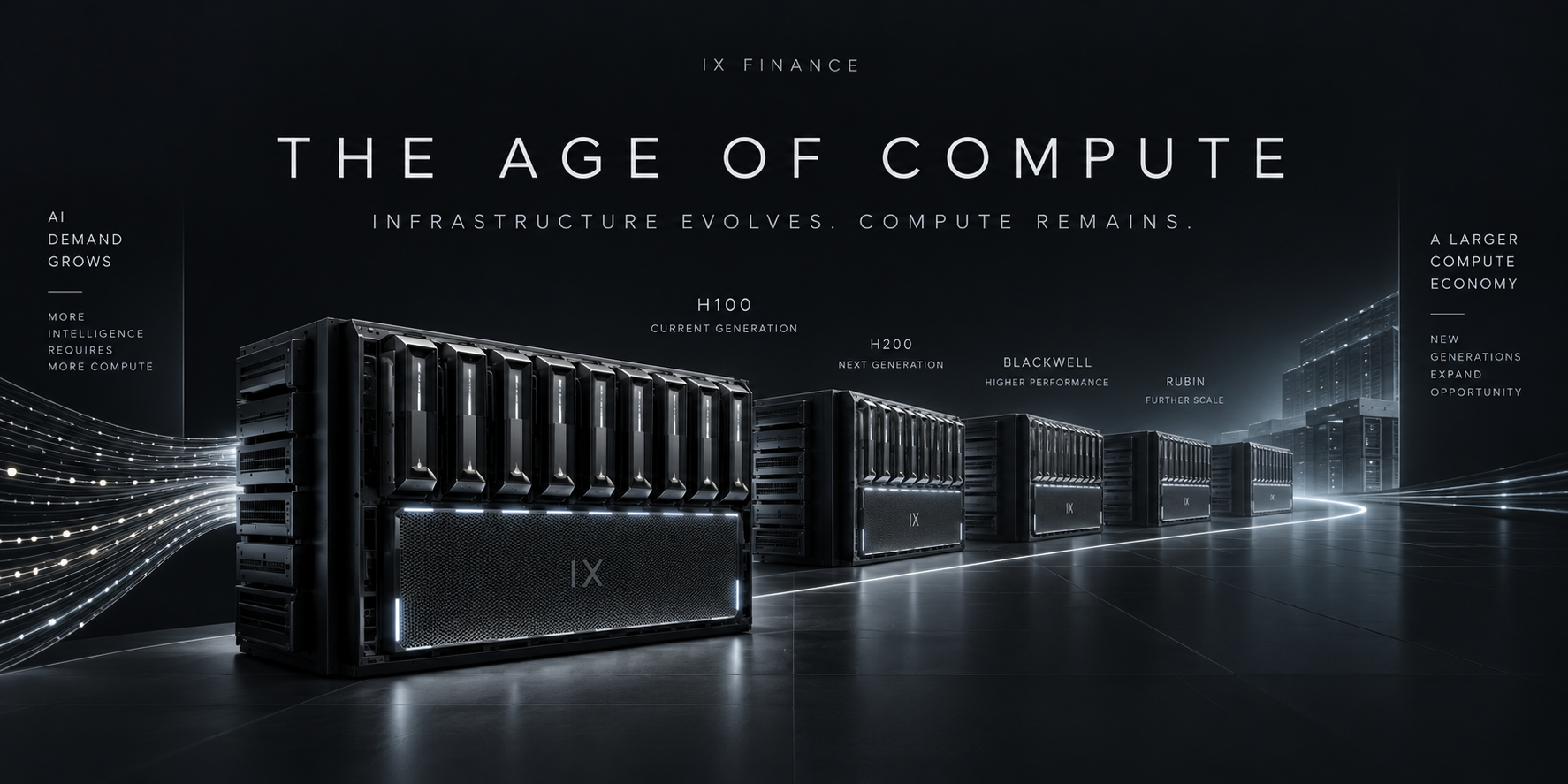
The Age of Compute: Why GPU Infrastructure Is Becoming a Strategic Asset
AI growth depends on physical compute. Explore why GPU fleets, data-center demand and reinvestment are turning productive compute infrastructure into a strategic asset.
The register is live.
IX-CORE is the first book on it, running on Base testnet and settling in test tokens. Nothing here is a live financial product.
Open the testnet