Why AI Infrastructure Is the First Real-World Asset on IX
AI compute is the most supply-constrained asset of the decade: demand is exploding, supply is not. Here's why IX tokenizes GPU infrastructure first — and what it means for owners.
IX tokenizes AI infrastructure first because it is the rare asset where demand is exploding while supply stays constrained — and where ownership has, until now, been locked behind institutional-scale capital. Fractionalizing GPU compute turns a scarce, income-producing asset into something anyone can own.
Key takeaways
- AI runs on physical infrastructure: GPUs, clusters, and data centers.
- That infrastructure is supply-constrained — chips are booked out, capacity is oversubscribed.
- It produces real, ongoing income from AI workloads.
- Tokenizing it turns a scarce, cash-generating asset into fractional, on-chain ownership.
The asset behind the AI boom
Every model, every inference call, every training run consumes one thing: compute. That compute is not abstract — it is racks of GPUs in real buildings, drawing real power, producing real output.
The demand for that compute is growing far faster than the world can build it. That imbalance is exactly what makes an asset valuable to own:
- GPU shortages are extreme — the chips that power AI are booked out for months.
- Data centers are oversubscribed — global capacity is spoken for faster than it is built.
- Capital requirements exclude most investors — ownership has meant millions.
Supply-constrained, income-producing, and gated
Most assets are two of three: scarce, productive, or accessible. AI infrastructure has historically been scarce and productive but completely inaccessible — you needed institutional capital and operational expertise to own any of it.
That combination — high demand, tight supply, real income, closed access — is the textbook case for tokenization. Fractional ownership removes the gate without touching what makes the asset valuable.
What "real yield" means here
Yield on IX is not an emission or an incentive. It is a share of the revenue the infrastructure actually earns when it runs AI workloads. When a tokenized cluster does work, the metered revenue settles on-chain and distributes to its owners.
That is the difference between real yield and printed yield: the cashflow has a source you can point to — a machine, doing work, for a customer.
Proof, not theory
This is not a whitepaper promise. On the IX v0.1 testnet:
- GPUs and clusters are already tokenized and live.
- Settlement happens on-chain.
- You can watch the full loop — own, power, earn — end to end.
Starting with AI infrastructure is a deliberate choice: prove the model on the highest-demand asset first, then expand into real estate and renewable energy from a working foundation.
Frequently asked questions
Why not start with real estate?
Real estate is on the roadmap. AI infrastructure is the sharpest demonstration of the model because the supply-demand gap is so extreme and the income is so directly measurable.
What generates the income?
AI workloads — training and inference — running on the tokenized clusters. Revenue is metered and settled on-chain.
Can I own this today?
AI infrastructure is live on the IX testnet now. Enter the testnet to see the tokenized clusters.
IX makes the backbone of AI ownable. Explore tokenized compute →
Keep reading
All posts →Tokenized GPUs vs. Tokenized Treasuries: Two Kinds of RWA Yield
Tokenized treasuries and tokenized GPU compute are both real-world assets, but they pay very different yields for very different reasons. Here's how they compare on source, upside, and risk — and where each fits in a portfolio.
 Thesis
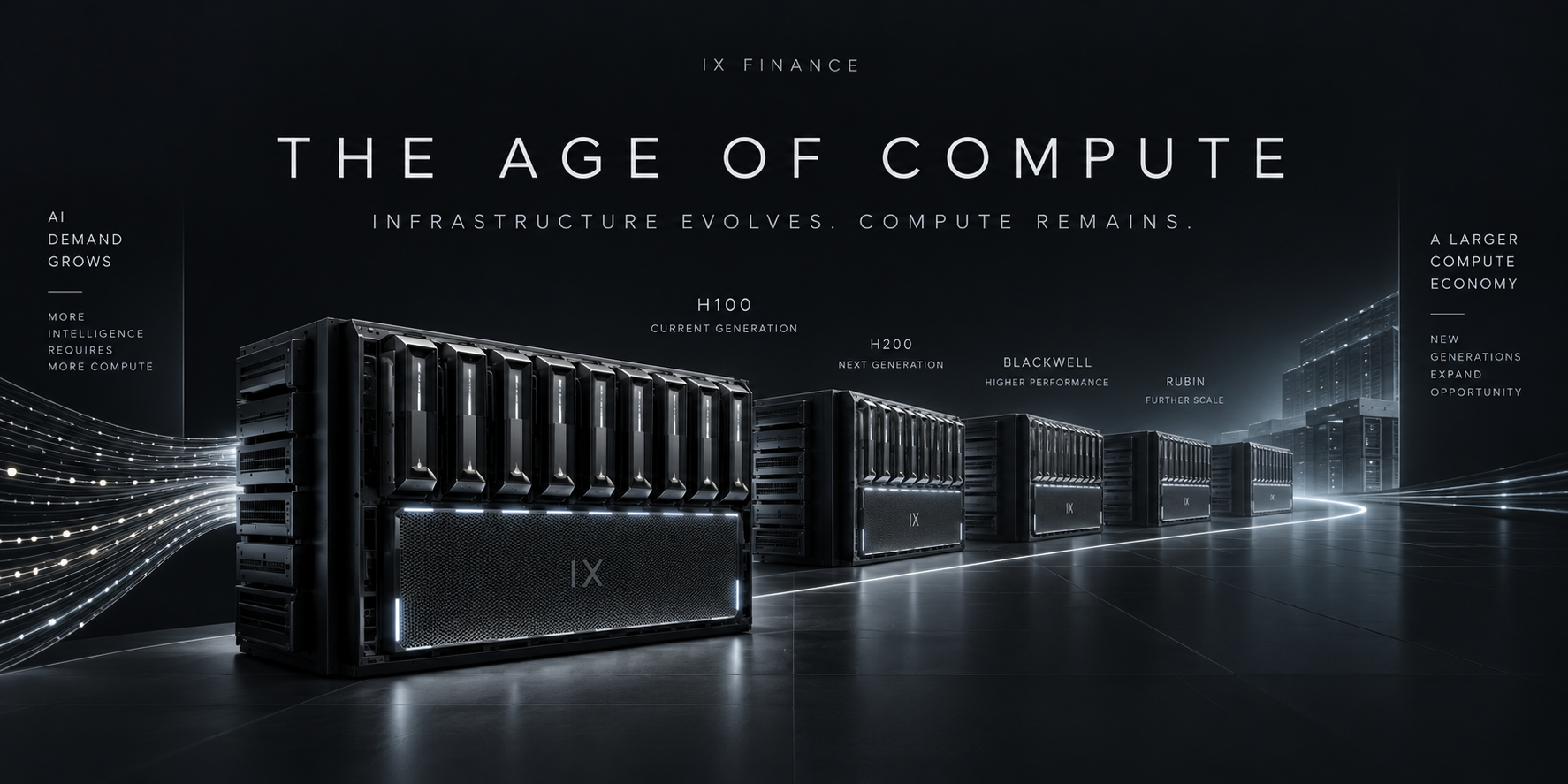
The Age of Compute: Why GPU Infrastructure Is Becoming a Strategic Asset
AI growth depends on physical compute. Explore why GPU fleets, data-center demand and reinvestment are turning productive compute infrastructure into a strategic asset.
The register is live.
IX-CORE is the first book on it, running on Base testnet and settling in test tokens. Nothing here is a live financial product.
Open the testnet