Tokenized GPUs vs. Tokenized Treasuries: Two Kinds of RWA Yield
Tokenized treasuries and tokenized GPU compute are both real-world assets, but they pay very different yields for very different reasons. Here's how they compare on source, upside, and risk — and where each fits in a portfolio.
Tokenized treasuries pay a low, stable yield from government interest, while tokenized GPU compute pays a variable, potentially higher yield from AI-workload revenue — one is a cash-equivalent, the other is productive infrastructure with upside. Both are real-world assets with genuine income, but they sit at opposite ends of the risk-and-return spectrum, and they play different roles.
Key takeaways
- Both are RWAs paying real yield — not emissions.
- Treasuries: low, stable yield tied to interest rates; effectively on-chain cash.
- Tokenized GPUs: variable yield from AI compute demand, with growth upside.
- They're complements, not substitutes — stability vs. productive scarcity.
Same category, different engines
The RWA label covers anything real represented on-chain — see What Are Real-World Assets?. But what earns the yield differs completely:
- Tokenized treasuries wrap short-term government debt. The yield is interest, set by rate policy. Very stable, very low variance — but capped by the rate, and it drops when rates drop.
- Tokenized GPU compute wraps productive AI infrastructure. The yield is rental revenue from AI workloads, driven by compute demand and utilization. More variable — but tied to a supply-constrained, growing market.
Head to head
| Tokenized treasuries | Tokenized GPU compute | |
|---|---|---|
| Yield source | Government interest | AI-workload rental revenue |
| Yield profile | Low, stable | Variable, higher potential |
| Value driver | Interest rates | Compute demand & scarcity |
| Upside | Minimal (rate-capped) | Tied to AI infrastructure growth |
| Main risk | Rate cuts, duration | Utilization / demand swings |
| Role | On-chain cash, ballast | Productive growth exposure |
Neither is "better" in the abstract — they answer different questions. Treasuries are where you park value; productive infrastructure is where you seek growth from a real, scarce asset.
The yield question that matters
Both pass the real-yield test — income comes from actual revenue, not token printing (see Real Yield, Explained). The difference is what you're exposed to. Treasury yield rises and falls with central-bank policy. Compute yield rises and falls with the demand for AI — a secular trend rather than a policy lever. If you believe AI demand keeps compounding, owning the infrastructure captures that; a treasury never will.
Where IX fits
IX is exposure to the productive end of the spectrum: tokenized AI infrastructure whose yield comes from real compute revenue. The IX-CORE index packages that book into a single NAV-anchored token, with reserves and revenue verifiable on-chain. For investors who already hold stable RWAs like tokenized treasuries, compute infrastructure is the complementary growth sleeve — scarce, income-producing, and tied to the defining demand curve of the decade. See why in Why AI Infrastructure Is the First RWA.
Frequently asked questions
Which has higher yield?
Tokenized GPU compute generally offers higher potential yield, because it's productive infrastructure rather than rate-capped debt — but with more variability.
Which is safer?
Tokenized treasuries have lower variance and behave like on-chain cash. Compute carries demand and utilization risk in exchange for upside.
Can I hold both?
Yes — that's often the point. Treasuries for stability, tokenized compute for growth exposure to AI infrastructure.
Want exposure to tokenized AI infrastructure? Enter the IX testnet or read the docs.
Keep reading
All posts →Why AI Infrastructure Is the First Real-World Asset on IX
AI compute is the most supply-constrained asset of the decade: demand is exploding, supply is not. Here's why IX tokenizes GPU infrastructure first — and what it means for owners.
 Thesis
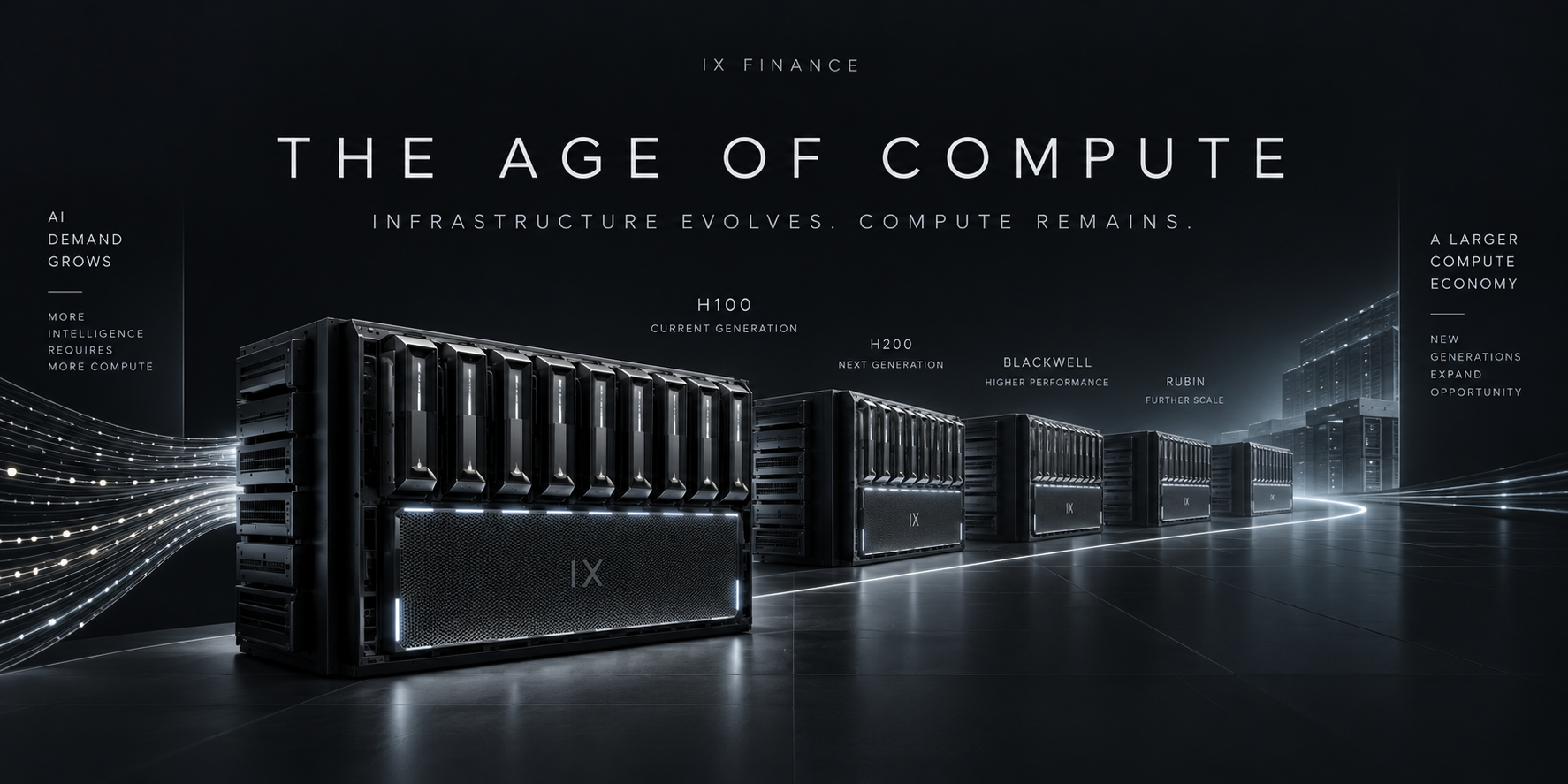
The Age of Compute: Why GPU Infrastructure Is Becoming a Strategic Asset
AI growth depends on physical compute. Explore why GPU fleets, data-center demand and reinvestment are turning productive compute infrastructure into a strategic asset.
The register is live.
IX-CORE is the first book on it, running on Base testnet and settling in test tokens. Nothing here is a live financial product.
Open the testnet