Private Markets Run on PDFs: The Ownership Record Problem
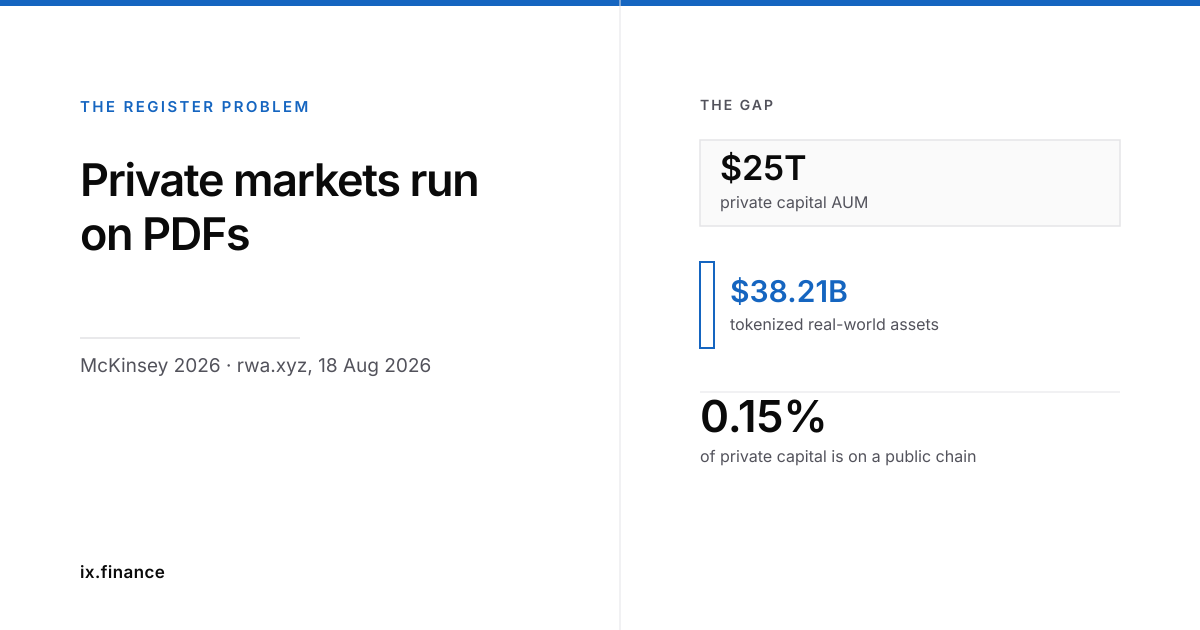
Private capital manages close to $25 trillion. Just $38 billion of real-world assets sit on a public chain. The gap is not technology — it is the register.
If you own shares in a listed company, proving it takes about four seconds. A registry holds the record, your broker reflects it, and anyone with a legitimate reason can confirm the position. Nobody asks you to email a scan.
Now try the same thing with a 3% stake in a private company, a participation in a direct loan, or a share of a warehouse. The proof is a PDF in a folder, a name on a spreadsheet a law firm maintains, and a subscription agreement nobody can check without asking permission.
That difference — not blockchain, not tokens — is the actual constraint on private markets.
Key takeaways
- Private capital AUM sits near $25 trillion (McKinsey, Global Private Markets Report 2026), while tokenized real-world assets total $38.21 billion (rwa.xyz, 18 August 2026) — about 0.15%.
- The bottleneck is the ownership record, not the asset. Private ownership is provable only by asking someone.
- Public chains fix checkability but break confidentiality, which is why institutional books have stayed off them.
- A register that is checkable and sealed is the missing primitive.
What is actually wrong with private market ownership?
Private ownership records are not wrong so much as unreachable. In 2026, McKinsey's Global Private Markets Report put closed-end private capital at roughly $16 trillion, with total private capital approaching $25 trillion once other alternative structures are counted. Every dollar of that is recorded somewhere. Almost none of it is recorded somewhere a third party can query.
Think about what "I own this" means in each market.
| Market | Who holds the record | Can a stranger verify it? |
|---|---|---|
| Listed equity | Central registry and brokers | Yes, in seconds |
| Government bonds | Clearing system | Yes |
| Private equity stake | Fund administrator, law firm | Only by asking the manager |
| Direct loan participation | Agent bank spreadsheet | Only by asking the agent |
| Titled property | Land registry, per jurisdiction | Sometimes, slowly |
The right-hand column is the whole story. Listed markets did not become liquid because the companies were better. They became liquid because the record became independent of the person claiming it.
Why does an unverifiable record cost so much?
Unverifiable ownership shows up as a discount, a delay, and a legal bill. Secondary transactions in private markets reached $240 billion in 2025, a 48% year-on-year rise and a large share of the cost in those deals is diligence on records that should have been queryable from the start.
Every party in a private transaction rebuilds the same picture from scratch. The buyer's counsel confirms the seller owns what they say. The lender confirms nothing senior sits ahead of them. The auditor confirms the position exists at year end. Four parties, four private investigations, one fact.
That is why exits take months, why minority stakes trade at a discount to any reasonable estimate of value, and why the phrase "illiquidity premium" quietly includes a large administrative component nobody itemises.
Illiquidity is usually described as a property of the asset. Much of it is a property of the paperwork. A building does not become easier to sell because it is on a chain — but a title whose owner can be confirmed without a three-week request removes real friction from every conversation about it.
Has tokenization solved this yet?
Not at any meaningful scale. As of 18 August 2026, the total distributed value of tokenized real-world assets was $38.21 billion, with 2,097,268 asset holders, up 61% over thirty days (rwa.xyz, retrieved 18 August 2026). Against roughly $25 trillion of private capital, that is about 0.15% — real growth on a rounding error.
The composition matters more than the total. Most of that value is in instruments that already had a working register: money market funds, Treasury products, gold. Genuinely private categories are thin. The largest single tokenized real estate position on rwa.xyz shows $89.9 million; the largest private equity position, $956.8 million.
So the assets that most need a better register have adopted it least. Why?
Because the first generation of tokenization answered a question nobody senior was asking. It offered fractional access and faster settlement. What a credit fund actually needs is to record a loan book without publishing the borrower list to competitors. Our reading of the category is that access was the easy problem and confidentiality was the real one — and the industry solved them in the wrong order. If you want the mechanics of how a claim is recorded on-chain in the first place, we covered them in how on-chain ownership actually works.
Why won't institutions just use a public blockchain?
Because a public chain publishes the book, and the book is confidential. A private credit manager who records positions transparently on a public ledger has disclosed the size of every borrower's facility, the identity of participants, and the timing of every drawdown — to competitors, to the borrower's suppliers, and to anyone running an indexer.
Regulators have been explicit that opacity is already a concern in private credit. The Financial Stability Board published a dedicated report on vulnerabilities in private credit in May 2026, and the IMF has flagged stale valuations, layered leverage and unclear interlinkages as system-level risks (FSB, Report on Vulnerabilities in Private Credit, 6 May 2026). But the answer institutions will accept is not "publish everything." It is "prove it to whoever has standing to ask."
That leaves two unattractive options and one that does not exist yet:
- Public chain, transparent. Checkable by anyone. Commercially unusable for a real book.
- Private chain, permissioned. Confidential. But you are back to trusting the operator, and nothing else can connect to it.
- Public chain, sealed claims. Amounts and owners encrypted, each balance carrying proof it is backed and solvent. Checkable without being readable.
The third option is where this goes. Real yield and proof-of-reserve mechanics both depend on it: a number you cannot verify is a claim, not a fact.
What does a working register have to do?
A register has to answer four questions without requiring trust in the person answering. In listed markets, the exchange and the clearing system do this so reliably that participants forget the function exists.
| Question | Listed markets | What a private register needs |
|---|---|---|
| Does this asset exist? | Issuer disclosure | Legal title in a named vehicle |
| Who owns it? | Central registry | On-chain identifier for the interest |
| Is the record current? | Real-time settlement | Attested updates, not typed-in ones |
| Can I check without permission? | Yes | Proof, without exposing the book |
Notice what is not on the list. There is no requirement for a token to trade, for a yield figure to be advertised, or for an asset class to be exciting. The register is plumbing. Its only job is to make one sentence checkable: this identifier represents that interest in that vehicle.
Everything people want from private markets — fractional participation, faster secondaries, borrowing against a stake — is downstream of that sentence being true and independently confirmable.
Where does IX fit?
IX Finance is building that register for unlisted ownership: an asset gets a legal vehicle, the interest gets an on-chain identifier, and the claim is designed to be sealed to the world but checkable by anyone with standing.
Being precise about status, because the category is full of overstatement: one book is live, and it is AI infrastructure, running on Base testnet with settlement in test tokens. The sealed-claim format — IX Cipher — is specified, not production code. Credit against the claim is designed and not built. There is no mainnet issuance.
The reason the first book is compute rather than private equity is not that compute is the biggest opportunity. It is that a cluster has a serial number, a contract and a revenue stream, which makes it the cheapest honest test of the rail. We wrote about that choice in why AI infrastructure is the first book, and about what qualifies an asset in what makes an asset worth tokenizing.
Frequently asked questions
Is tokenization the same thing as a register?
No. Tokenization creates a transferable representation of an asset. A register establishes who owns what and lets that be checked independently. You can tokenize an asset and still have an unverifiable ownership record — most of the first wave did exactly that.
Why are tokenized Treasuries growing faster than private assets?
Treasuries already had a functioning register, a daily price and no confidentiality problem. Tokenizing them adds settlement speed with nothing to lose. A private credit book has a confidentiality problem first, which no amount of settlement speed solves.
Does a register make private assets liquid?
Not on its own. It removes the diligence and verification friction that makes transfers slow and expensive. Liquidity also needs willing buyers, a defensible valuation method and, usually, a venue. The register is the precondition, not the outcome.
Who checks the record if there is no exchange?
In the model IX is building, the chain holds the identifier and the proof, while attestors sign the inputs that change value. The design intent is that no single operator — including the issuer — can assert a number unchallenged. Today the compute book's oracle is self-attested, which is a gap we label rather than gloss.
The short version
Private markets are not held back by a shortage of capital or of interesting assets. They are held back by the fact that ownership is provable only by asking the person who benefits from the answer.
Fix the record and the rest becomes negotiable. Leave it as a PDF, and every transaction pays the same tax forever.
Background reading: what real-world assets on-chain actually are, and how to invest in the first book.
Keep reading
All posts →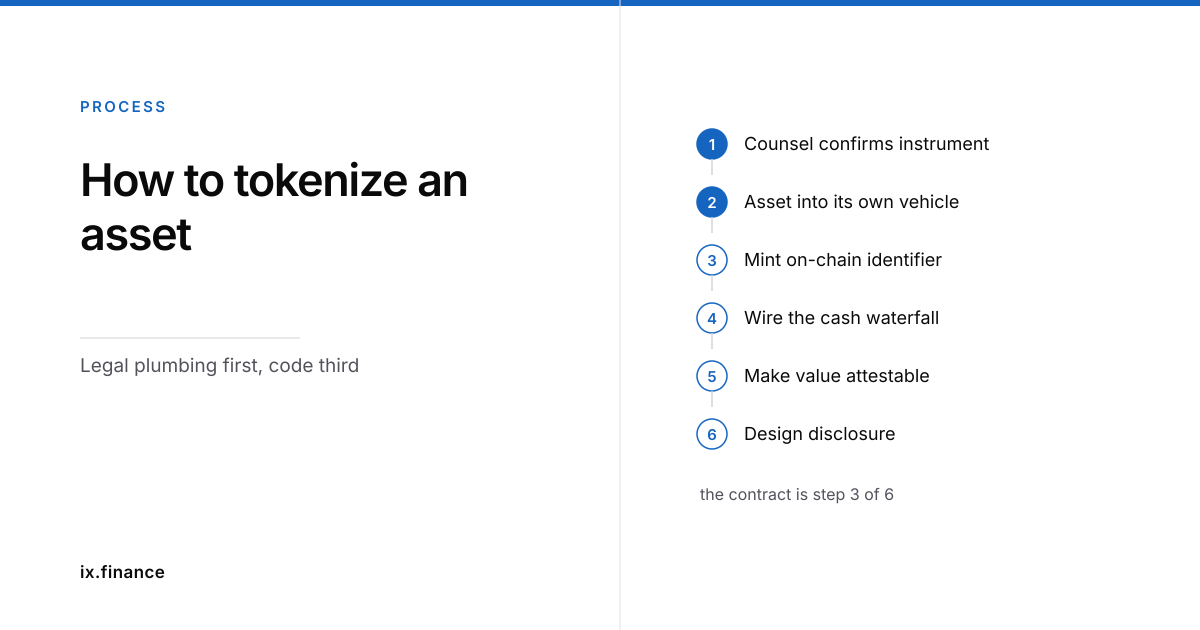 Guide
GuideHow to Tokenize an Asset: The Six Steps Nobody Skips
Tokenization is 10% smart contract and 90% legal plumbing. The six steps between a real asset and a claim someone can verify, in the order they must happen.
 Explainer
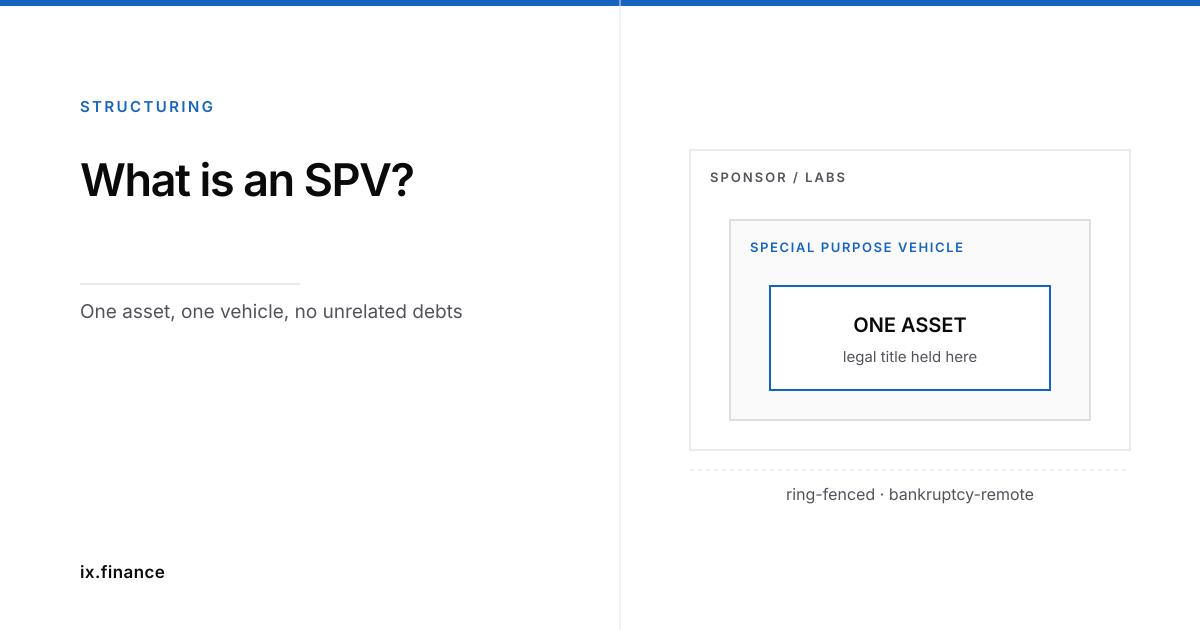
What Is an SPV? Special Purpose Vehicles in Plain English
A special purpose vehicle holds one asset and nothing else. Here is why almost every private deal uses one, what bankruptcy-remote means, and how SPVs fail.
The register is live.
IX-CORE is the first book on it, running on Base testnet and settling in test tokens. Nothing here is a live financial product.
Open the testnet