Proof of Reserve & NAV: How to Verify a Tokenized Asset Is Real
A tokenized asset is only as trustworthy as your ability to check it. Here's how proof of reserve, on-chain NAV, and asset-identity anchoring let you verify that an RWA token is backed by something real — without taking anyone's word for it.
You verify a tokenized asset by checking three things on-chain: that the underlying assets exist (proof of reserve), what they're worth (net asset value, or NAV), and that each token maps to a real, identified asset (identity anchoring). When all three are recomputable from public data, you don't have to trust the issuer — you can confirm the backing yourself.
Key takeaways
- Proof of reserve shows the assets backing the tokens actually exist.
- NAV shows what those assets are worth — and should be recomputable from on-chain inputs.
- Identity anchoring ties each token to a specific, real asset, not a vague pool.
- "Trust me" is not a feature. "Check it yourself" is.
Why verification is the whole game
An RWA token is a claim on something off-chain. That claim is only worth what you can confirm. Without verification, a tokenized asset is just an IOU — and the history of finance is full of IOUs that turned out to be backed by less than advertised. On-chain transparency exists to remove that leap of faith. (New to the category? Start with What Are Real-World Assets?.)
The three pillars of verifiability
1. Proof of reserve — do the assets exist?
A public, on-chain registry of the real assets backing the tokens, with reserve coverage you can inspect. It answers the first question anyone should ask: is there actually something behind this?
2. NAV — what is it worth?
Net asset value is the per-token value of the underlying. The key property is that NAV should be recomputable: the inputs (the assets, their rates, the revenue) live on-chain, so anyone can rebuild the number rather than accept a dashboard figure.
3. Identity anchoring — is each token tied to a real asset?
Reserves and NAV mean more when each unit maps to a specific, identified asset — down to the machine and its serials, hashed on-chain. That turns "a pool of assets somewhere" into "these exact assets, verifiably."
What good transparency looks like
| Question | Weak answer | Verifiable answer |
|---|---|---|
| Do the assets exist? | "Audited annually" | Public on-chain reserve registry |
| What's the value? | A number on a dashboard | NAV recomputable from on-chain inputs |
| Is revenue real? | "Trust our reporting" | Attested revenue with an on-chain trail |
| Which assets? | "A diversified pool" | Each token anchored to identified assets |
Where IX fits
IX is built so the backing is checkable, not merely claimed. Assets are anchored on-chain with real machine and per-GPU serial identity; NAV is recomputable from authoritative on-chain inputs; and revenue is attested with an on-chain trail, so income is verifiable rather than asserted. The /transparency view surfaces these live inputs directly. The underlying ownership mechanics are covered in How On-Chain GPU Ownership Works.
Frequently asked questions
What is proof of reserve?
A verifiable, on-chain demonstration that the assets backing a set of tokens actually exist and cover them.
Why does NAV need to be "recomputable"?
So you don't have to trust a reported figure. If the inputs are public, anyone can rebuild NAV and confirm it independently.
What is asset-identity anchoring?
Binding each token to a specific real asset — hashed identity such as machine and serial numbers on-chain — so tokens map to real things, not a vague pool.
Does verification remove all risk?
No. It removes trust risk about whether the backing exists. Market and operational risk on the asset itself still apply.
Want to verify tokenized AI infrastructure yourself? Enter the IX testnet or read the docs.
Keep reading
All posts →What Are Real-World Assets (RWAs)? A Plain-English Guide
Real-world assets (RWAs) are physical or traditional financial assets — property, infrastructure, credit — represented on-chain as tokens. Here's how tokenized ownership actually works, and why it matters.
 Guide
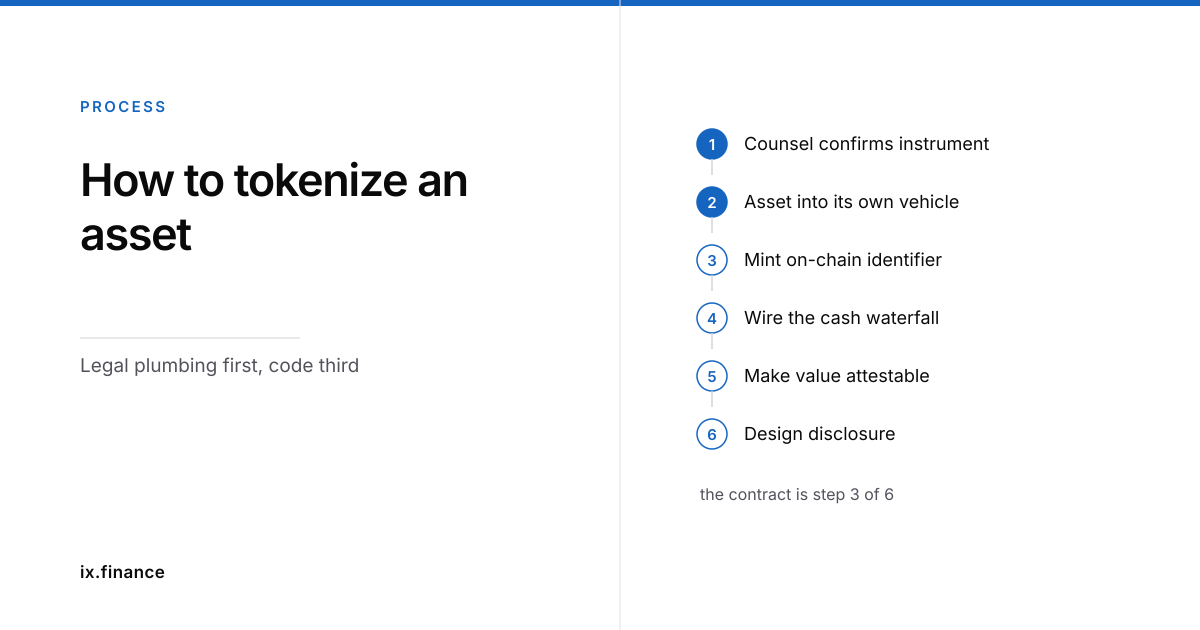
GuideHow to Tokenize an Asset: The Six Steps Nobody Skips
Tokenization is 10% smart contract and 90% legal plumbing. The six steps between a real asset and a claim someone can verify, in the order they must happen.
The register is live.
IX-CORE is the first book on it, running on Base testnet and settling in test tokens. Nothing here is a live financial product.
Open the testnet