How to Tokenize an Asset: The Six Steps Nobody Skips
Tokenization is 10% smart contract and 90% legal plumbing. The six steps between a real asset and a claim someone can verify, in the order they must happen.
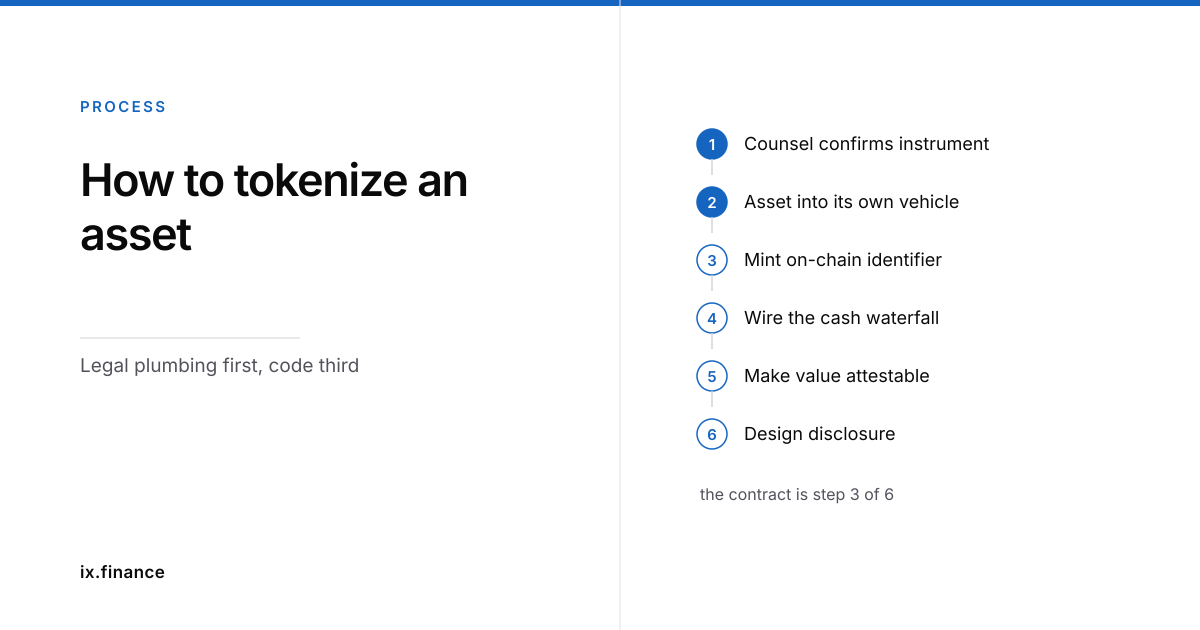
Most tokenization projects fail at step two and discover it at step six.
The engineering is the easy part. Minting a token that represents an interest in something takes an afternoon. Making that token correspond to an enforceable claim on a real asset, with cash that actually reaches holders, takes months of legal and operational work that no contract can shortcut.
Here is the sequence, in the order it has to happen, and what goes wrong at each stage.
Key takeaways
- Tokenization is sequential: legal title must be secured before an identifier means anything.
- Total tokenized real-world assets reached $38.21 billion by August 2026 (rwa.xyz), concentrated in instruments that already had working registers.
- The steps that fail most often are title assignment and the cash waterfall — not the smart contract.
- A token without a vehicle holding title is a promise, not a claim.
Step 1: Confirm the instrument with counsel
Before anything technical, you need a lawyer's answer to one question: what exactly is being sold? An interest in a company, a note, a participation in a loan, a beneficial interest in a trust? Each answer carries different securities treatment in each jurisdiction where a holder might live.
Skipping this is the single most expensive mistake in the category. Regulators have been increasingly direct about private market conduct — the FCA's March 2025 review of valuation practices identified conflicts around investor fees, asset transfers, subscriptions and redemptions (Financial Conduct Authority, Private market valuation practices, March 2025). Those are the same pressure points a tokenized structure inherits, with more holders and faster transfers.
What you need out of step one: a written classification of the instrument, the jurisdictions you can offer it in, and the eligibility rules for holders.
Step 2: Put the asset in its own vehicle
One asset, one vehicle. The vehicle holds legal title, has no unrelated debts, and sits off the sponsor's balance sheet. Without this, a token is a claim on a company that also owes money to other people for other reasons.
This is the step where projects quietly stall, because it requires the real thing to actually move: a deed registered, a serial-numbered machine assigned, a loan participation novated. Announcing a partnership is not assignment. An MOU is not title.
| What you need | What is often presented instead |
|---|---|
| Executed assignment of title into the vehicle | A letter of intent with the operator |
| A binding offtake or lease | A pipeline discussion |
| Vehicle formed and in good standing | Vehicle named in a deck |
| Independent bank account for the vehicle | Sponsor's account with internal tagging |
We covered the structure itself in what an SPV is and why every private deal uses one. For tokenization the relevant point is narrow: the chain records a claim on the vehicle, so the vehicle must genuinely hold the asset.
If you can't name the document that transferred title, and the date it was executed, the asset is not in the vehicle. Every honest tokenization has a boring answer to that question. Every troubled one has a story.
Step 3: Mint the on-chain identifier
Now the technical part, and it is the shortest section for a reason. A registry contract records an identifier for the vehicle's interest — a stable reference that other systems can point at.
What the identifier should carry:
- A reference to the vehicle and the asset it holds
- The valuation method that applies to this asset class
- Where revenue and NAV inputs come from, and who signs them
- Whether the interest is standalone or included in an index
What it should not carry is a promise. An identifier that asserts a value nobody attests to is a number typed into a database with extra steps. The mechanics of doing this properly are in how on-chain ownership actually works.
Step 4: Wire the cash waterfall
Revenue has to reach the vehicle's bank account and leave it in a documented order. This is operational plumbing — bank mandates, reconciliation, reporting cadence — and it decides whether holders ever receive anything.
The order is not negotiable after the fact:
| Priority | Payment |
|---|---|
| 1 | Operating costs of the asset |
| 2 | Reserve accounts (debt service, maintenance) |
| 3 | Debt service, where the vehicle is leveraged |
| 4 | Insurance and contingency |
| 5 | Distribution to holders, pro-rata |
| 6 | Sponsor fee or carry, ring-fenced from vehicle creditors |
A structure that pays the sponsor before the reserves is a structure that will fail its first bad quarter. Where does the money actually originate? That question is worth asking bluntly, as we did in who actually pays the yield.
Step 5: Make the value attestable
The asset's value and income must be signed by someone other than the person who benefits from the number being high. This is the difference between a verifiable claim and a marketing figure.
Practically, that means:
- Inputs sourced from observable market data, not internal assumptions
- A staleness rule, so an un-updated value is visibly stale rather than silently trusted
- Signing keys held by attestors, with the issuer unable to write values alone
- A public method anyone can recompute from the same inputs
The gap between design and practice here is common, including in our own build. IX's compute book takes live market rates as inputs, but the oracle is currently self-attested and settlement uses test tokens on Base testnet. That is a labelled gap, not a solved problem. Proof of reserve and NAV verification covers what a complete version requires.
Step 6: Decide what holders can see — and what they can prove
The final step is disclosure design. A public chain publishes everything by default, which is unusable for most private books: a credit fund cannot broadcast borrower facility sizes, and a property owner rarely wants tenant terms indexed.
So you choose between three postures, and only one of them scales to institutional books:
| Posture | Confidentiality | Verifiability |
|---|---|---|
| Transparent on a public chain | None | Full, by anyone |
| Permissioned private chain | Good | Requires trusting the operator |
| Sealed claims on a public chain | Good | Proof without disclosure |
The third is where the category is heading and where most of the work remains. It is the format IX Cipher specifies — and being accurate about status, it is specification and documentation, not production code.
Tokenized real-world assets totalled $38.21 billion across 2,097,268 holders as of 18 August 2026 (rwa.xyz, retrieved 18 August 2026). The categories that grew fastest are the ones with no confidentiality requirement at all. That is not a coincidence, and it tells you which step is really the hard one.
Frequently asked questions
How long does tokenizing an asset take?
The contract work takes days. Counsel opinion, vehicle formation, title assignment and bank wiring typically take two to six months for a first asset, faster afterwards once the template exists. Anyone quoting two weeks is describing step three only.
Do you need a token to tokenize?
You need a record. Whether the claim is an ERC-20 balance, a vault share or a sealed note is an implementation choice. The requirement is that the record is authoritative and independently checkable, not that it is tradeable.
What makes an asset a bad candidate?
No clear title, no contractual cash flow, or a value that cannot be derived from observable inputs. Listed securities are also poor candidates — they already have a functioning register. We set out the test in what makes an asset worth tokenizing.
Who is liable if the on-chain record and the legal record disagree?
The legal record governs, which is exactly why the two must be bound by documentation rather than convention. A structure that has not addressed this in writing has an unresolved dispute waiting in it.
The short version
Tokenization is a legal and operational exercise with a software component, not the reverse. Title first, vehicle second, identifier third, cash fourth, attestation fifth, disclosure last.
Get the order wrong and you have a token with a story attached. Get it right and you have something a stranger can check.
Related reading: private credit, explained, and real yield — because every step above depends on a number, and that number is contested.
Sources
- rwa.xyz, Tokenized real-world asset dashboard, retrieved 2026-08-21 — https://app.rwa.xyz/
- Financial Conduct Authority, Private market valuation practices, 5 March 2025, retrieved 2026-08-21 — https://www.fca.org.uk/publications/multi-firm-reviews/private-market-valuation-practices
Keep reading
All posts →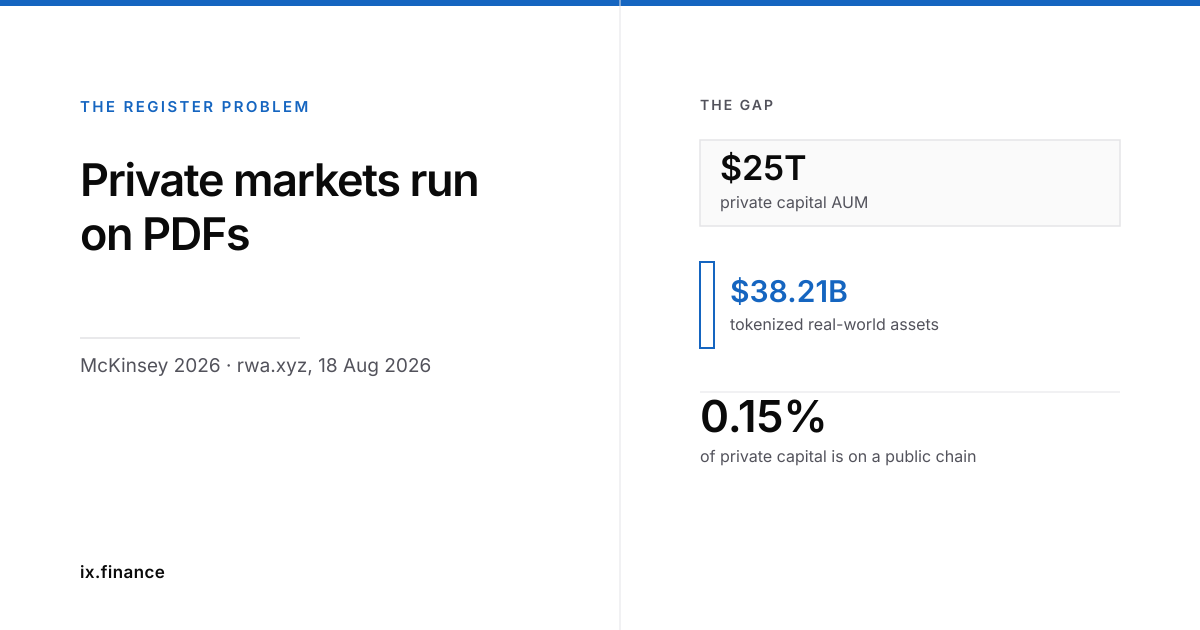 Thesis
Private Markets Run on PDFs: The Ownership Record Problem
Private capital manages close to $25 trillion. Just $38 billion of real-world assets sit on a public chain. The gap is not technology — it is the register.
What Makes an Asset Worth Tokenizing?
What makes a real-world asset worth tokenizing? Explore the role of ownership, verification, access, settlement, and productive cash flow in RWA tokenization.
The register is live.
IX-CORE is the first book on it, running on Base testnet and settling in test tokens. Nothing here is a live financial product.
Open the testnet