Private Credit, Explained: How Direct Lending Actually Works
Private credit AUM passes $2 trillion in 2026. Here is how a direct loan is originated, priced and recovered — and the three risks regulators keep naming.
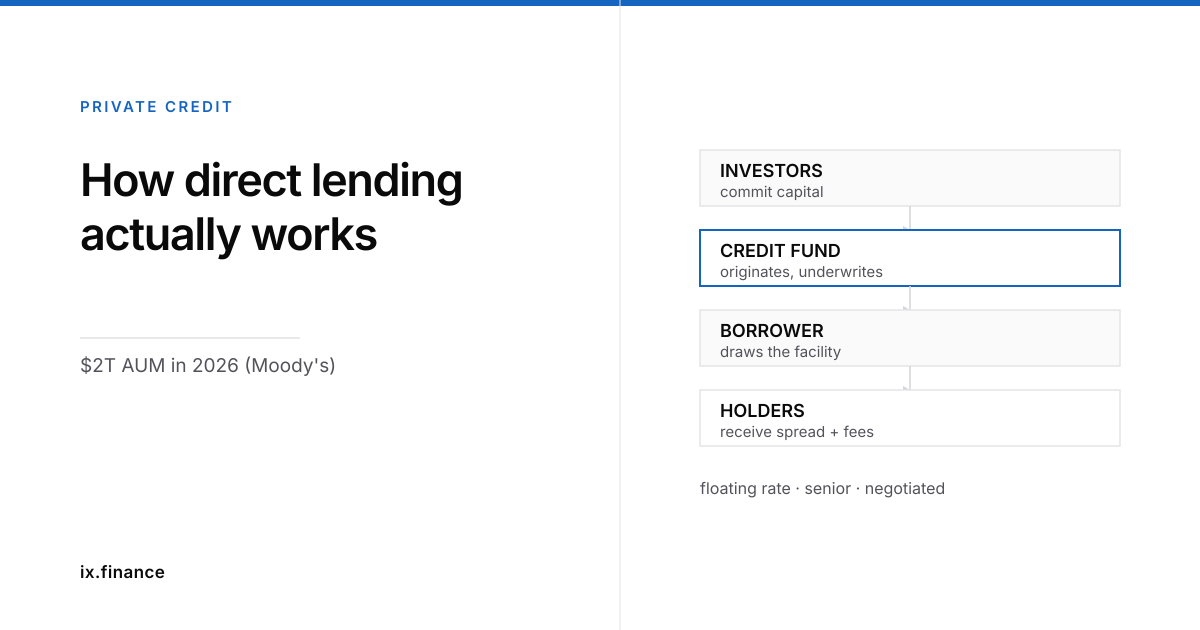
Private credit is lending that happens outside the public bond market and outside a bank's balance sheet. A fund raises capital from institutions, lends it directly to companies, and collects interest until the loan is repaid.
That is the whole product. No exchange, no daily price, no prospectus.
It has grown from a niche into one of the largest pools of capital in finance, which is why regulators have started writing reports about it rather than footnotes.
Key takeaways
- Private credit AUM exceeds $2 trillion in 2026 and is projected to approach $4 trillion by 2030 (Moody's, Private credit outlook 2026, January 2026).
- Direct lending is the dominant strategy: floating-rate, senior, negotiated one-to-one with the borrower.
- Returns come from spread and fees, not price appreciation — which makes recovery rates the number that matters.
- The IMF and FSB have both flagged stale valuations, layered leverage and opacity as the sector's structural weak points.
What is private credit, precisely?
Private credit is a negotiated loan held by a fund rather than traded by a market. Moody's expects assets under management to exceed $2 trillion during 2026, approaching $4 trillion by 2030 (Moody's Ratings, Private credit outlook 2026, 21 January 2026). Growth on that scale has come mostly from one strategy: direct lending to mid-market companies.
The distinction from a corporate bond is worth being exact about.
| Corporate bond | Private credit loan | |
|---|---|---|
| Buyer | Anyone in the market | One fund, or a small club |
| Terms | Standardised | Negotiated per deal |
| Rate | Usually fixed | Usually floating |
| Price | Quoted daily | Marked quarterly by the manager |
| Exit | Sell into the market | Hold to maturity, or negotiate |
| Documentation | Public prospectus | Private credit agreement |
The right-hand column explains both the appeal and the risk. Negotiated terms mean tighter covenants and faster execution for the borrower. No quoted price means nobody outside the manager knows precisely what the loan is worth until something forces the question.
Where does the return actually come from?
It comes from spread over a floating base rate, plus fees at origination — not from an asset rising in value. A private credit loan that performs exactly as written returns interest and principal. There is no upside beyond the contract.
That single fact reshapes how you should read a private credit return:
- The base rate is not skill. When policy rates are high, headline yields are high. That is the environment, not the manager.
- The spread is the compensation for risk. How much extra the borrower pays for going private instead of public.
- Fees are paid before you see anything. Origination and management fees come off the top.
- Losses are the only real variable. In a portfolio of contractual loans, performance dispersion comes almost entirely from which loans go bad and how much is recovered.
So the honest question about any private credit fund is not "what is the yield?" It is "what happens in the loans that stop paying, and where do I sit when that happens?" We wrote about that framing more generally in real yield, explained.
Seniority beats headline rate. A senior secured position at a modest spread will usually outperform a subordinated position at a higher one across a full credit cycle — because recovery, not coupon, decides the outcome on the loans that fail. The SPV waterfall is where you find out which one you own.
How is a direct loan put together?
A direct loan is originated one deal at a time, with the lender doing its own diligence and drafting its own terms. The sequence is consistent across managers.
- Sourcing. A sponsor, adviser or the borrower approaches the fund. Relationships matter more than screens.
- Diligence. Financials, contracts, customer concentration, management. Weeks, not minutes.
- Structuring. Seniority, security, covenants, amortisation, the rate over the base.
- Documentation. A credit agreement written for this borrower, held privately.
- Funding. Capital drawn from LP commitments and advanced to the borrower.
- Monitoring. Quarterly reporting, covenant testing, and amendments when things drift.
- Exit. Repayment, refinancing, or a workout.
Step six is where most of the value and most of the risk lives. A lender who spots deterioration two quarters early can renegotiate from strength. One who finds out at default is negotiating from weakness.
What are the real risks?
The risks regulators keep naming are not credit losses — they are measurement and structure. The IMF has identified fragile borrowers, a growing share of semi-liquid vehicles, multiple layers of leverage, stale and potentially subjective valuations, and unclear connections between participants. The Financial Stability Board published a dedicated report on private credit vulnerabilities in May 2026 (FSB, Report on Vulnerabilities in Private Credit, 6 May 2026).
Three of those deserve unpacking.
Stale valuations. A loan marked quarterly by the entity earning fees on it is a valuation with a conflict attached. The FCA's multi-firm review of private market valuation practices, published 5 March 2025, found conflicts arising specifically around investor fees, asset transfers, redemptions and subscriptions, and secured borrowing — and noted that valuation committee minutes often lacked detail on how decisions were actually reached (Financial Conduct Authority, Private market valuation practices, March 2025).
Layered leverage. The borrower is leveraged. The fund may borrow against its portfolio. The investor may borrow to fund its commitment. Each layer is individually defensible and collectively opaque.
Opacity. Nobody outside a deal can see its terms. That is the borrower's legitimate commercial interest — and also the reason system-wide risk is hard to measure.
Is that an argument against private credit? No. It is an argument for being able to verify claims without publishing the book, which is the constraint we described in the ownership record problem.
How does private credit compare to tokenized alternatives?
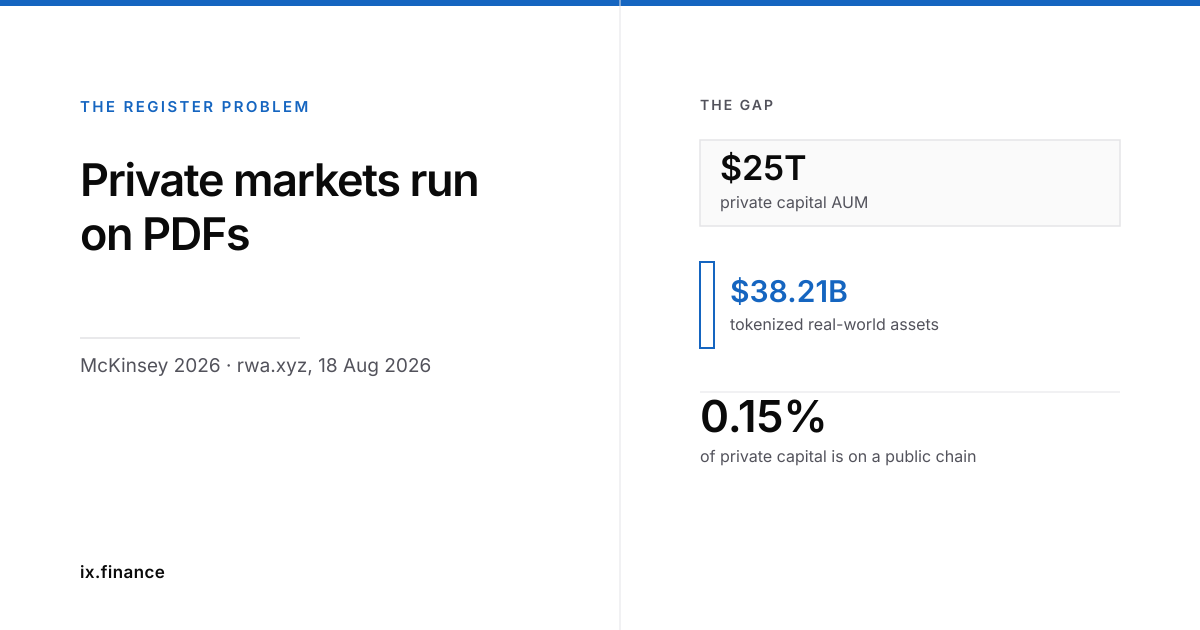
Tokenized private credit is one of the larger categories of on-chain real-world assets, but it remains a rounding error against the underlying market. Total tokenized real-world assets stood at $38.21 billion as of 18 August 2026 (rwa.xyz, retrieved 18 August 2026) — against a $2 trillion private credit market, that is a fraction of a percent even before separating credit from Treasuries and commodities.
Putting a loan book on-chain changes the record, not the credit. The borrower can still fail. What changes is that participation can be recorded, transferred and verified without a bilateral request to the agent — provided the tape stays sealed. A manager who has to publish every borrower's facility size to use the rail will simply not use the rail.
For how this differs from lending against government paper, see tokenized GPUs versus tokenized treasuries — the same distinction between contractual income and market income applies.
Frequently asked questions
Is private credit safer than high-yield bonds?
Different, not safer. Private loans are usually senior, secured and covenanted, which helps recovery. They are also unquoted and illiquid, so you cannot exit a deteriorating position by selling. The trade is documentation strength for optionality.
Why do borrowers pay more to borrow privately?
Speed, certainty and flexibility. A direct lender can commit to a complex or time-sensitive deal without a syndication process or public disclosure. Borrowers pay a premium over public market pricing for that certainty.
What happens when a private credit borrower defaults?
The lender negotiates directly — amendment, additional security, an equity injection, or enforcement against collateral. Because the lender often holds the entire loan, workouts are bilateral rather than fought among hundreds of bondholders. Outcomes depend heavily on seniority and security.
How often is private credit valued?
Typically quarterly, by the manager, sometimes with third-party input. The FCA found most firms had valuation committees, which improved independence, but flagged inconsistency in ad hoc valuations and in documenting how conclusions were reached.
The short version
Private credit is a contractual return business. You get paid the spread if the loan performs, and the outcome on the loans that do not perform decides everything else.
The sector's weakness is not the lending. It is that the record and the marks both sit with the party being paid. Any improvement worth having addresses that without forcing managers to publish their book.
Related reading: what an SPV is, and how on-chain ownership actually works.
Sources
- Moody's Ratings, Private credit outlook 2026, 21 January 2026, retrieved 2026-08-20 — https://www.moodys.com/web/en/us/insights/credit-risk/outlooks/private-credit-2026.html
- Financial Stability Board, Report on Vulnerabilities in Private Credit, 6 May 2026, retrieved 2026-08-20 — https://www.fsb.org/uploads/P060526.pdf
- Financial Conduct Authority, Private market valuation practices, 5 March 2025, retrieved 2026-08-20 — https://www.fca.org.uk/publications/multi-firm-reviews/private-market-valuation-practices
- rwa.xyz, Tokenized real-world asset dashboard, retrieved 2026-08-20 — https://app.rwa.xyz/
Keep reading
All posts →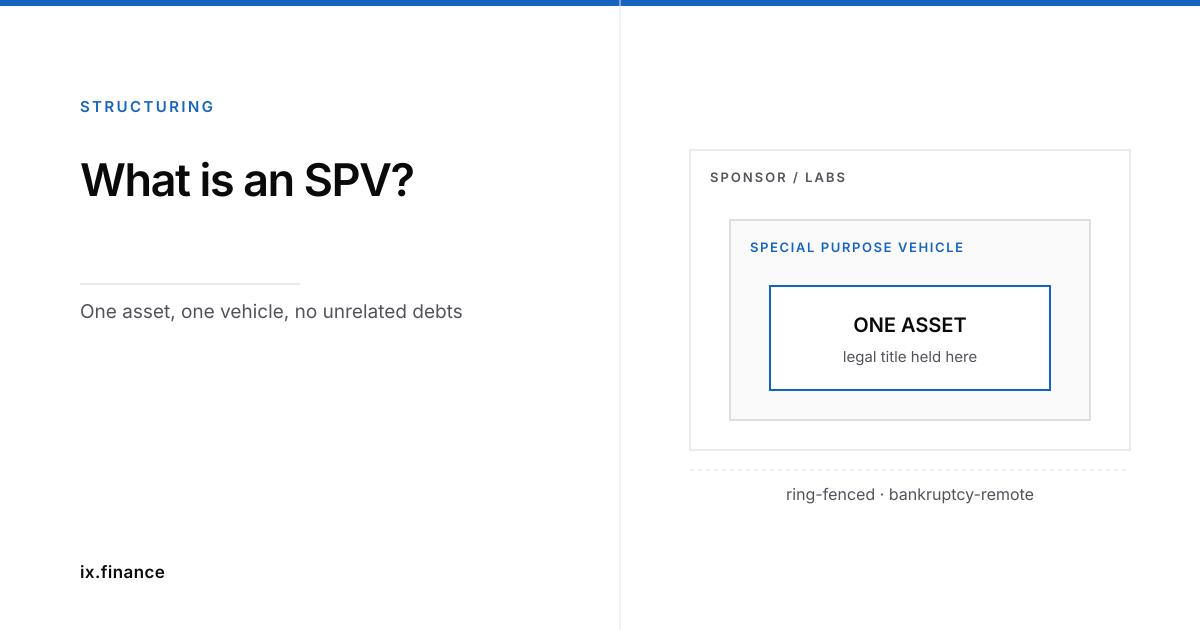 Explainer
What Is an SPV? Special Purpose Vehicles in Plain English
A special purpose vehicle holds one asset and nothing else. Here is why almost every private deal uses one, what bankruptcy-remote means, and how SPVs fail.
 Thesis
Private Markets Run on PDFs: The Ownership Record Problem
Private capital manages close to $25 trillion. Just $38 billion of real-world assets sit on a public chain. The gap is not technology — it is the register.
The register is live.
IX-CORE is the first book on it, running on Base testnet and settling in test tokens. Nothing here is a live financial product.
Open the testnet