How On-Chain Ownership of GPU Compute Actually Works
From a physical GPU cluster to a fractional token that pays you when it runs AI workloads — a step-by-step look at how IX turns real compute into on-chain, income-producing ownership.
On-chain GPU ownership works by binding a physical cluster to a legal claim, tokenizing that claim into fractions, and settling the revenue the cluster earns back to token holders on-chain. The machine stays in the data center; the ownership and the cashflow move to the blockchain.
Key takeaways
- A real GPU cluster is held in a legal structure and represented as fractional tokens.
- Buying a token buys a proportional, legally-bound claim on that cluster.
- When the cluster runs AI workloads, it produces metered revenue.
- That revenue settles on-chain and distributes to owners automatically.
Step 1 — A real cluster, a real claim
It starts with hardware: a GPU cluster in a data center, capable of running training and inference workloads. That cluster is placed inside a legal structure that actually owns it. Tokens issued against that structure are therefore bound to a real ownership claim — not a synthetic exposure.
Step 2 — Tokenizing the claim
The claim is divided into fractional units and issued on-chain. Each unit represents a proportional share of the cluster. This is what makes an otherwise indivisible, expensive asset ownable in small pieces:
- One cluster becomes many fractional tokens.
- Each token maps to a known share of the underlying.
- Ownership records live on-chain, transparent and transferable.
Step 3 — The cluster does work
A tokenized cluster is not idle. It runs AI workloads — the training and inference that AI products depend on. Each unit of work is metered: how much compute was used, for how long, producing how much revenue.
That metering is the bridge between physical output and on-chain settlement. It turns "the machine ran" into a verifiable number.
Step 4 — Revenue settles on-chain
The metered revenue flows back through the protocol and distributes to token holders, proportional to ownership. Because distribution is on-chain, it is:
- Transparent — you can see what was earned and paid.
- Proportional — your share tracks your ownership exactly.
- Automatic — no manual claims process for each distribution.
Why "proof" matters
The credibility of the whole loop rests on being able to prove the work happened. Signed usage telemetry — a receipt that a run occurred and produced revenue — is what lets owners trust the yield and lets builders verify the revenue. Without provable settlement, on-chain ownership is just a wrapper; with it, the token is anchored to real, verifiable output.
The loop, in one line
Own → Power → Earn. You own a fraction of a cluster. The cluster powers AI workloads. The revenue earns you a proportional, on-chain distribution. Repeat every time the machine works.
Frequently asked questions
Do I hold the physical GPU?
No — the hardware stays in the data center where it can actually run workloads. You hold a fractional, legally-bound claim on it and its revenue.
How is my share of revenue calculated?
Proportional to your ownership. If you own 1% of a cluster's tokens, you receive 1% of the distributed revenue from that cluster.
Where can I see this working?
The IX v0.1 testnet has GPUs and clusters tokenized and settling on-chain today. Enter the testnet to follow the full loop.
See on-chain compute ownership live. Enter the IX testnet →
Keep reading
All posts → Thesis
Everyone Wants a Piece of AI. Few Are Looking at the Layer Beneath It.
AI exposure does not have to mean picking an AI company. Explore how productive GPU infrastructure creates a different thesis built around compute demand, operating economics and fractional ownership.
 Thesis
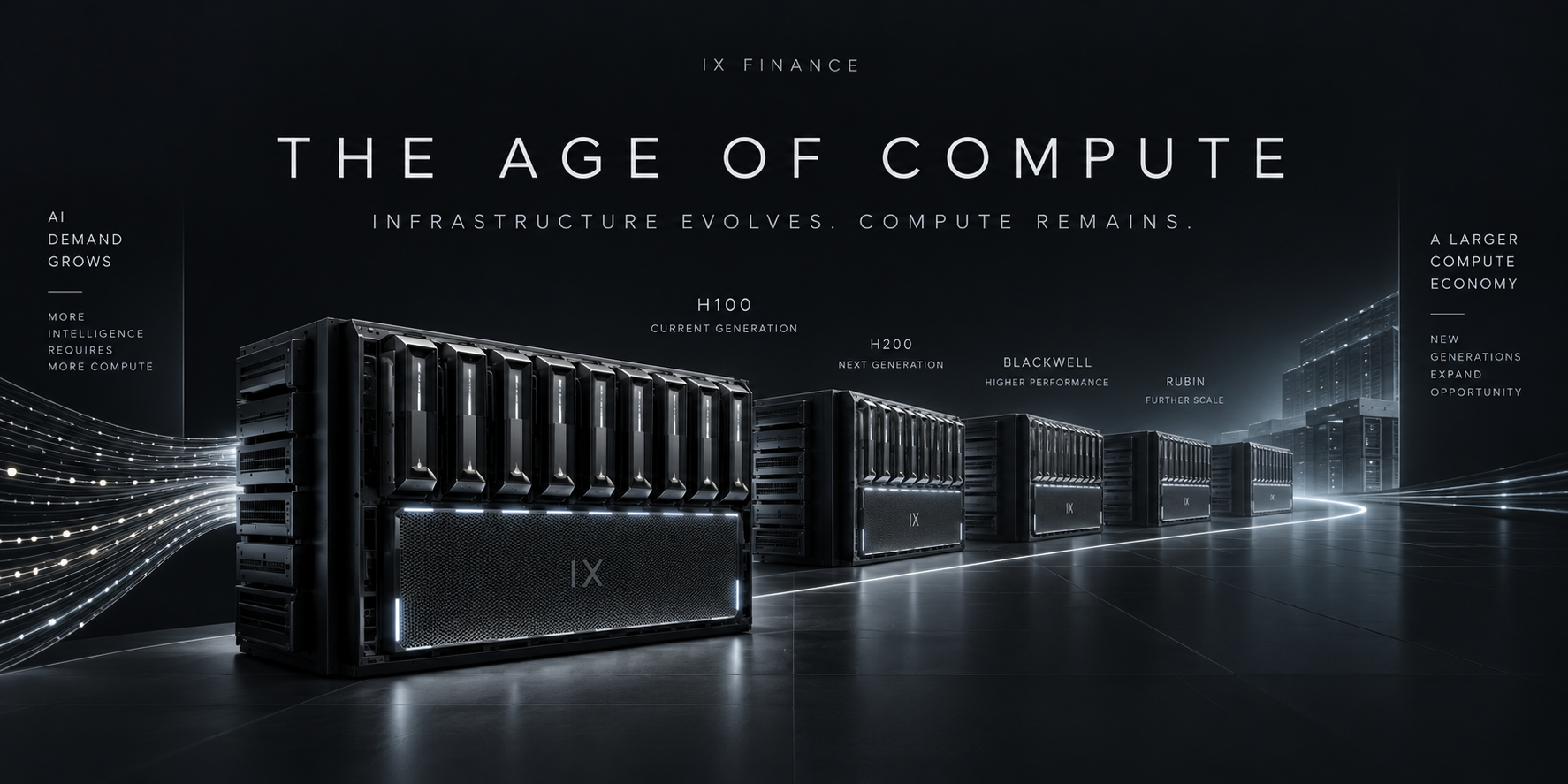
The Age of Compute: Why GPU Infrastructure Is Becoming a Strategic Asset
AI growth depends on physical compute. Explore why GPU fleets, data-center demand and reinvestment are turning productive compute infrastructure into a strategic asset.
The register is live.
IX-CORE is the first book on it, running on Base testnet and settling in test tokens. Nothing here is a live financial product.
Open the testnet