What Are Real-World Assets (RWAs)? A Plain-English Guide
Real-world assets (RWAs) are physical or traditional financial assets — property, infrastructure, credit — represented on-chain as tokens. Here's how tokenized ownership actually works, and why it matters.
Real-world assets (RWAs) are physical or traditional financial assets — like real estate, infrastructure, or private credit — that are represented on a blockchain as tokens. Each token is a claim on a real, off-chain asset, so ownership, transfers, and income can settle on-chain while the underlying asset keeps doing its job in the real world.
Key takeaways
- An RWA token is a claim on something real — not a standalone coin with nothing behind it.
- Tokenization splits a single expensive asset into fractions anyone can own.
- Income the asset earns (rent, yield, compute revenue) can be distributed on-chain, automatically.
- The blockchain is the ownership and settlement layer — the asset stays physical.
Why tokenize an asset at all?
For most of history, the best assets shared three traits: high minimums, operational complexity, and closed access. Owning a data center, a solar farm, or an institutional property meant millions in capital and a team to run it.
Tokenization changes the ownership layer, not the asset. By representing an asset as divisible on-chain units, it becomes possible to:
- Fractionalize — own a slice instead of the whole thing.
- Settle transparently — every transfer and distribution is recorded on-chain.
- Compose — use the token across other on-chain systems (collateral, indices, markets).
RWAs vs. ordinary crypto tokens
The distinction that matters is what backs the token.
| Typical crypto token | Real-world asset token | |
|---|---|---|
| Backed by | Market sentiment / protocol utility | A real, off-chain asset |
| Income source | Speculation, emissions | Operating revenue (rent, yield, compute) |
| Value anchor | Supply & demand | The underlying asset's value |
| What you own | A token | A fractional claim on real property |
The point of an RWA is that the value has a floor in something physical and productive — the token is the wrapper, not the substance.
How an RWA works, end to end
- A real asset is acquired and placed in a legal structure that holds it.
- Ownership is tokenized — the asset is represented as fractional units bound to that legal claim.
- Investors buy fractions of the asset directly, on-chain.
- The asset generates revenue from its normal operation.
- Income is distributed on-chain, proportional to ownership.
The blockchain handles ownership records and settlement. The asset handles earning.
Where IX fits
IX starts with the most supply-constrained asset of the decade: AI infrastructure. GPU clusters and data-center compute are tokenized as fractional ownership, and the income from AI workloads settles on-chain to the people who own them. Real estate and renewable energy follow on the roadmap.
The v0.1 testnet is live on BNB Chain, with GPUs and clusters already tokenized — so you can see the full loop, from fractional ownership to on-chain settlement, working today.
Frequently asked questions
Is an RWA token real ownership?
Yes — a properly structured RWA is a fractional interest in a real, income-generating asset, bound to a legal claim. It is not a token with nothing behind it.
Where do returns come from?
From the asset's operating revenue — property income, energy production, or, in IX's case, revenue from AI compute workloads. Not from speculation.
Is this the same as crypto?
The asset is physical and real. The blockchain is used only for transparent ownership tracking and distributions.
Are there minimums?
Fractional ownership removes the traditional million-dollar minimums — you can start from a fraction and add over time.
Want to see tokenized AI infrastructure in action? Enter the IX testnet or read the docs.
Keep reading
All posts →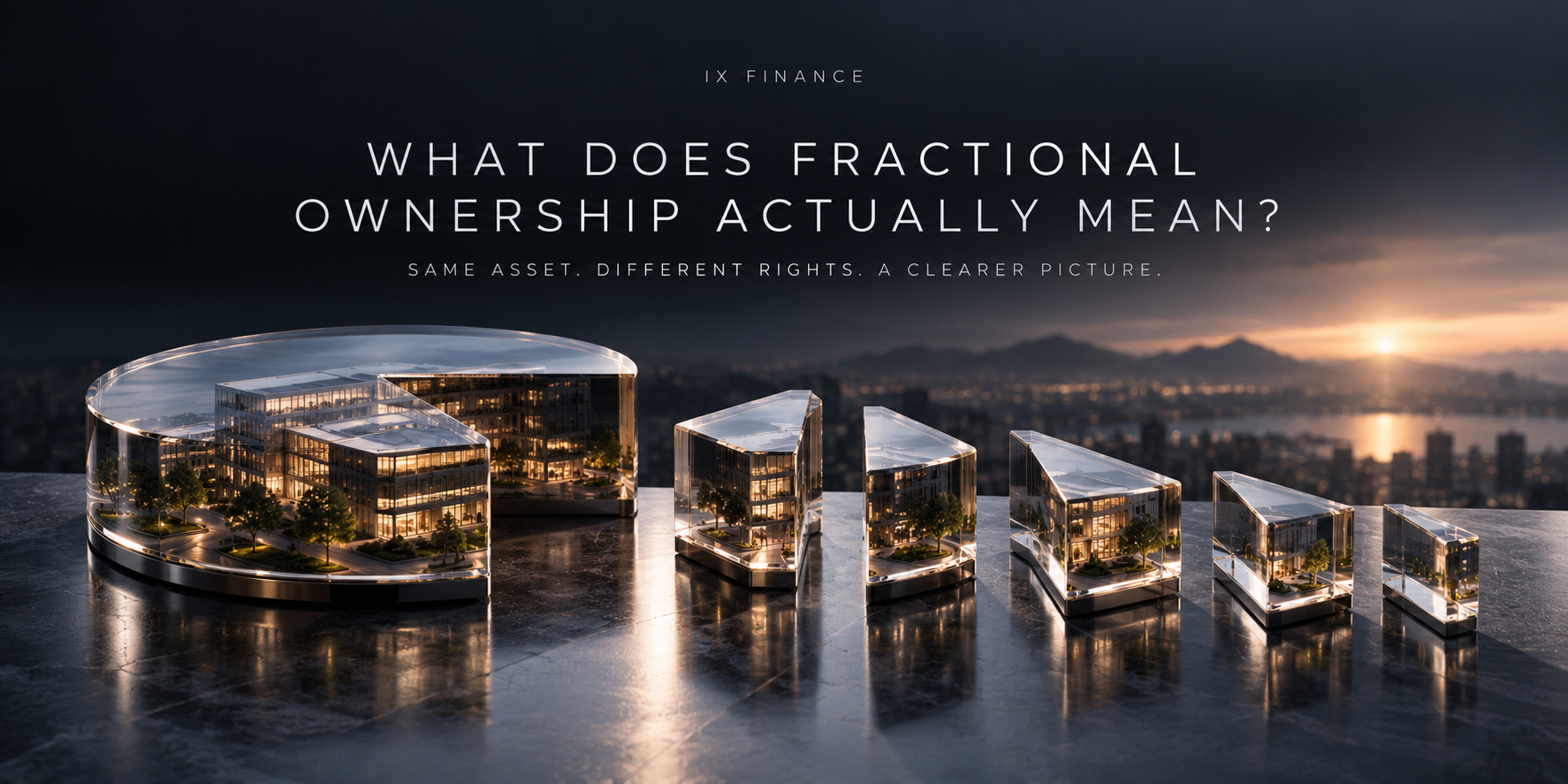 Explainer
What Does Fractional Ownership Actually Mean?
Fractional ownership is more than dividing an asset into smaller pieces. Learn how legal ownership, economic rights, revenue rights and token representation differ.
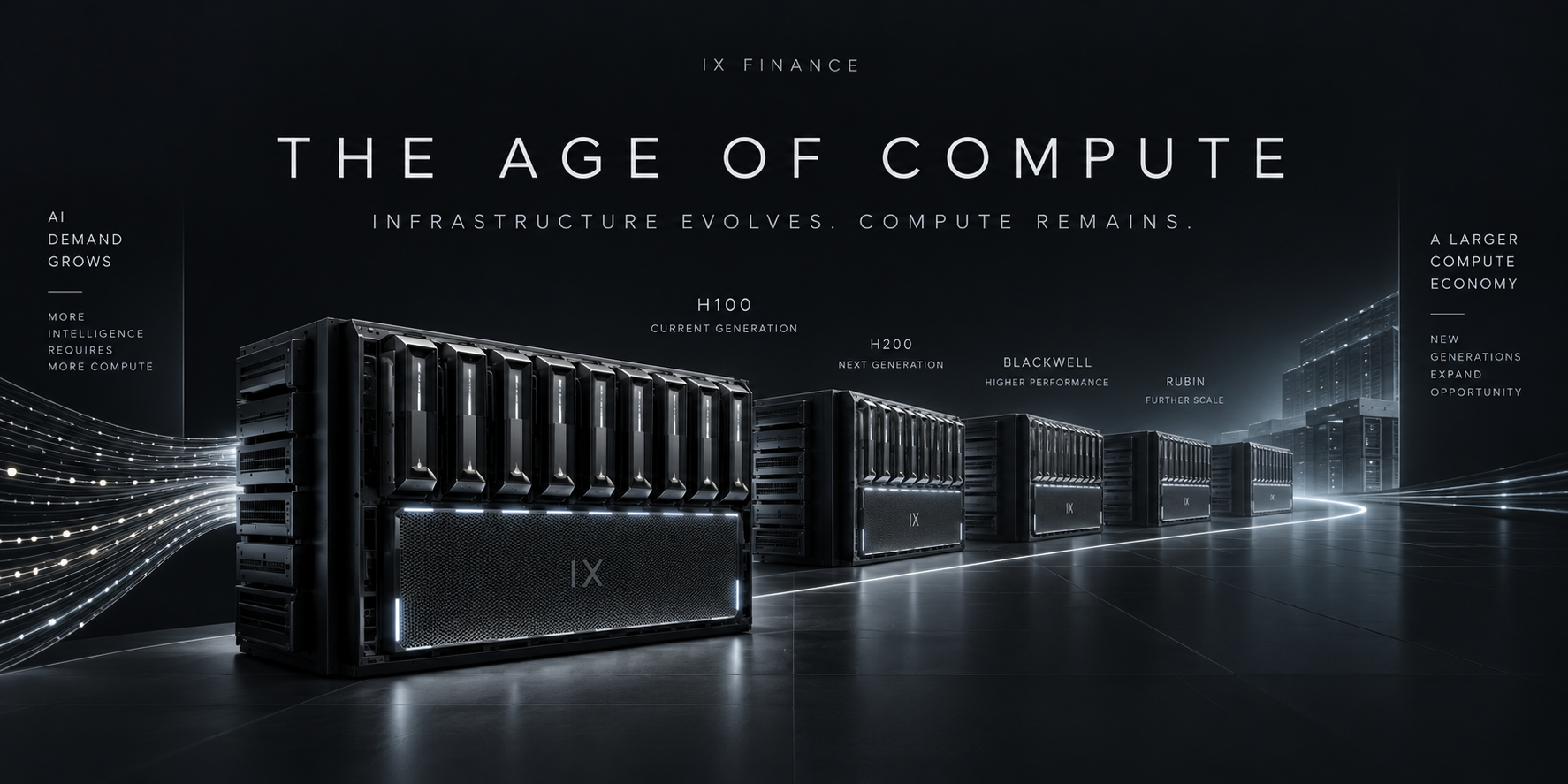 Thesis
The Age of Compute: Why GPU Infrastructure Is Becoming a Strategic Asset
AI growth depends on physical compute. Explore why GPU fleets, data-center demand and reinvestment are turning productive compute infrastructure into a strategic asset.
The register is live.
IX-CORE is the first book on it, running on Base testnet and settling in test tokens. Nothing here is a live financial product.
Open the testnet