What Is an SPV? Special Purpose Vehicles in Plain English
A special purpose vehicle holds one asset and nothing else. Here is why almost every private deal uses one, what bankruptcy-remote means, and how SPVs fail.
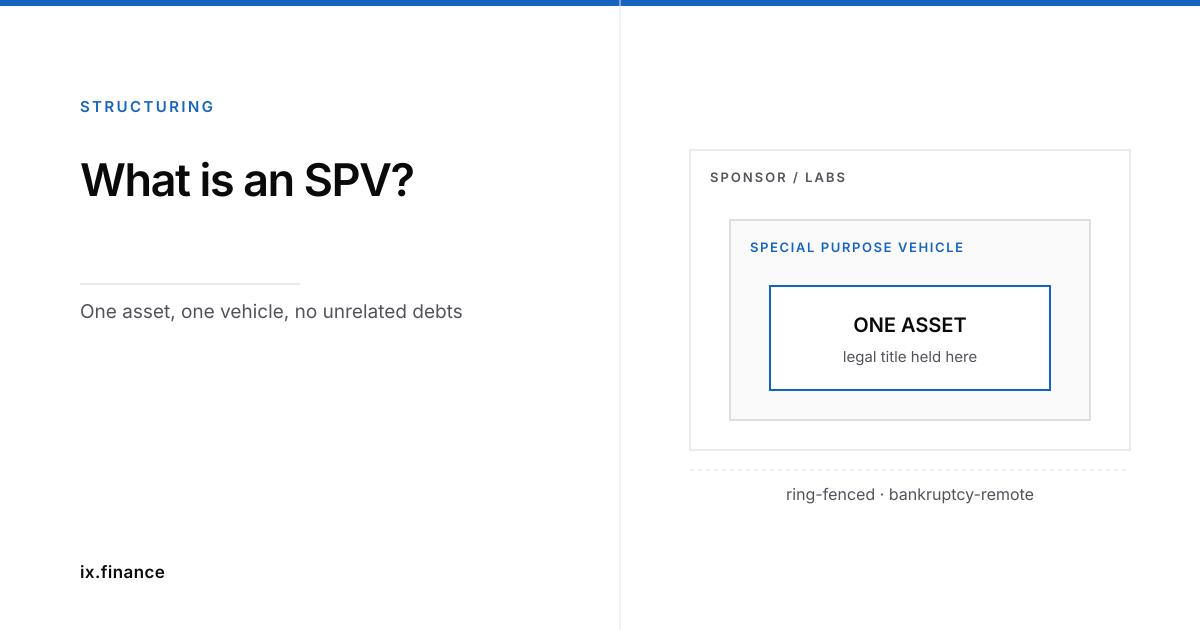
A special purpose vehicle is a company built to hold one thing and do nothing else. No employees, no other business, no unrelated debts. One asset, one set of accounts, one purpose written into its constitution.
That sounds like a technicality. It is the reason a pension fund will finance a wind farm, a bank will lend against an aircraft, and a private equity firm can sell one portfolio company without touching the other eleven.
If you invest in anything unlisted, you are almost certainly investing through one of these. It is worth understanding what it does and where it breaks.
Key takeaways
- An SPV is a legal container holding a single asset, isolated from its sponsor's other liabilities.
- "Bankruptcy-remote" means the sponsor's failure should not drag the asset into the sponsor's insolvency — it is a design goal, not a guarantee.
- Private capital AUM approaches $25 trillion (McKinsey, Global Private Markets Report 2026), and the overwhelming majority of it sits inside vehicles like these.
- The SPV solves legal isolation. It does nothing about whether outsiders can verify who owns it.
What does an SPV actually do?
An SPV separates one asset's risk from everything else its sponsor touches. Private capital AUM is approaching $25 trillion, with closed-end structures alone near $16 trillion (McKinsey & Company, Global Private Markets Report 2026, February 2026) — and structuring at that scale is only workable because each asset can be ring-fenced from the others.
Three things follow from the isolation:
- Creditors are contained. A lender to the SPV has recourse to the asset in it. Not to the sponsor's other holdings.
- The asset survives the sponsor. If the manager fails, the vehicle and its asset are meant to stand apart from that failure.
- The asset becomes sellable on its own. You can transfer the shares of the vehicle rather than re-papering the underlying title.
That last point is the commercial engine. Transferring a building means deeds, taxes, registrations and months. Transferring the company that owns the building can mean a share purchase agreement.
What does "bankruptcy-remote" really mean?
It means the structure is designed so the sponsor's insolvency does not automatically capture the asset. That is a design objective backed by specific drafting, not a magic property. Courts have consolidated vehicles with their sponsors where the separation was cosmetic.
The features that make remoteness credible are unglamorous:
| Feature | What it prevents |
|---|---|
| Restricted purpose clause | Vehicle taking on unrelated business or debt |
| Independent director or manager | Sponsor filing the vehicle into insolvency at will |
| Separate books, accounts, filings | Commingling that lets a court treat both as one |
| Non-petition and limited recourse terms | Creditors reaching beyond the ring-fenced asset |
| No cross-guarantees to the sponsor | The vehicle backstopping its parent's obligations |
Remoteness is earned by behaviour, not by naming. A vehicle whose bank account is operated like a pocket of the sponsor's treasury, whose filings are late, and whose only director is the founder, is a vehicle a liquidator will argue about. The paperwork has to match the conduct for years, not just at closing.
Why does every private deal use one?
Because private assets are lumpy, financed individually, and sold individually. Ring-fencing is the only way to price one asset without pricing the sponsor's whole business alongside it.
Consider a lender looking at a single data centre. Without an SPV, lending against that facility means underwriting the operator's entire enterprise: other sites, other debts, other litigation. With an SPV holding the facility, the credit question narrows to the facility, its contracts and its cash flows.
The same logic drives the secondaries market. Secondary transaction volume hit $240 billion in 2025, up 48% year on year, split between $120 billion of LP-led and $106 billion of GP-led deals (Jefferies, Global Secondary Market Review, January 2026). Those transfers are practical largely because interests sit in discrete vehicles that can change hands without dismantling the underlying asset.
How does cash move through an SPV?
Cash arrives in the vehicle and leaves in a fixed order. This ordering — the waterfall — is where investor protection actually lives, and it is more informative than any headline return figure.
A typical monthly sequence:
| Step | Payment | Purpose |
|---|---|---|
| 1 | Operating costs | Keep the asset running |
| 2 | Reserve top-up | Debt service reserve account |
| 3 | Debt service | Interest and principal, if leveraged |
| 4 | Maintenance and insurance reserves | Preserve the asset |
| 5 | Distribution | Whatever remains goes to holders |
Read that table again from the bottom. Distributions are residual. They come after every prior claim is satisfied. An advertised yield that does not tell you where in the waterfall you sit is not telling you much — a point we made in detail in real yield, explained and in who actually pays the yield.
What problem does an SPV not solve?
It does not make ownership verifiable. The vehicle is a container with clean legal boundaries, and the record of who owns that container is still a register maintained privately — a share register at a corporate services provider, a fund administrator's system, a law firm's file.
So an SPV gives you isolation and transferability while leaving the verification gap open. To confirm you own an interest in one, someone has to ask the party holding the register, and that party decides whether to answer.
This is exactly the gap described in the ownership record problem. An SPV makes an asset financeable. It does not make ownership of it checkable.
How do SPVs connect to on-chain ownership?
An on-chain register records who holds the interest in the vehicle, while the vehicle continues to hold legal title in the real world. The chain does not own the asset — it records the claim on the entity that does.
The sequence is short: real asset, its own vehicle, an identifier on-chain for the interest, then a claim held by the investor. Nothing about the legal structure changes. What changes is that the record of holders stops being a private spreadsheet.
Tokenized real-world assets totalled $38.21 billion as of 18 August 2026 across 2,097,268 holders (rwa.xyz, retrieved 18 August 2026). Every credible structure in that figure has a vehicle like this underneath it. Where the vehicle is missing, the token is a promise rather than a claim — which is why verifying reserves and NAV matters more than the wrapper.
At IX Finance, one asset per vehicle is the standing rule, and the vehicles sit off the operating company's balance sheet. The compute book is live on Base testnet with settlement in test tokens; the sealed-claim format is specified rather than built. Getting legal title of a real asset into a vehicle is the work that makes the rest meaningful, and it is not finished.
Frequently asked questions
Is an SPV the same as a holding company?
No. A holding company owns interests in multiple subsidiaries and often has its own strategy and debts. An SPV is restricted by design to a single asset or a defined cohort, and its constitution limits what it can do. The restriction is the feature.
Can an SPV go bankrupt?
Yes. If the asset stops generating enough cash to service the vehicle's own debt, the SPV can fail. Remoteness protects the sponsor from the asset and the asset from the sponsor. It does not protect the asset from itself.
Who controls an SPV day to day?
Usually the sponsor, through a management agreement, with constraints written into the vehicle's documents and sometimes an independent director whose consent is needed for insolvency filings or changes of purpose. Control is deliberately narrow.
Does putting an SPV interest on-chain change its legal status?
Not by itself. The on-chain identifier records the claim; enforceability still comes from the vehicle's documents and the law of its jurisdiction. Anyone describing a token as ownership without a vehicle holding title is describing something else.
The short version
An SPV is one asset in one box, with the lid held on by drafting and years of consistent conduct. It makes private assets financeable and transferable, and it is the reason private markets function at all at their current size.
What it will never do on its own is let a stranger confirm you own the box. That is a register problem, and it is the next one to solve.
Related reading: what real-world assets on-chain actually are, and how on-chain ownership works.
Sources
- McKinsey & Company, Global Private Markets Report 2026, February 2026, retrieved 2026-08-19 — https://www.mckinsey.com/industries/private-capital/our-insights/global-private-markets-report
- Jefferies, 2025 Global Secondary Market Review, January 2026, retrieved 2026-08-19 — https://www.jefferies.com/insights/the-big-picture/2025-global-secondary-market-review-another-record-breaking-year/
- rwa.xyz, Tokenized real-world asset dashboard, retrieved 2026-08-19 — https://app.rwa.xyz/
Keep reading
All posts →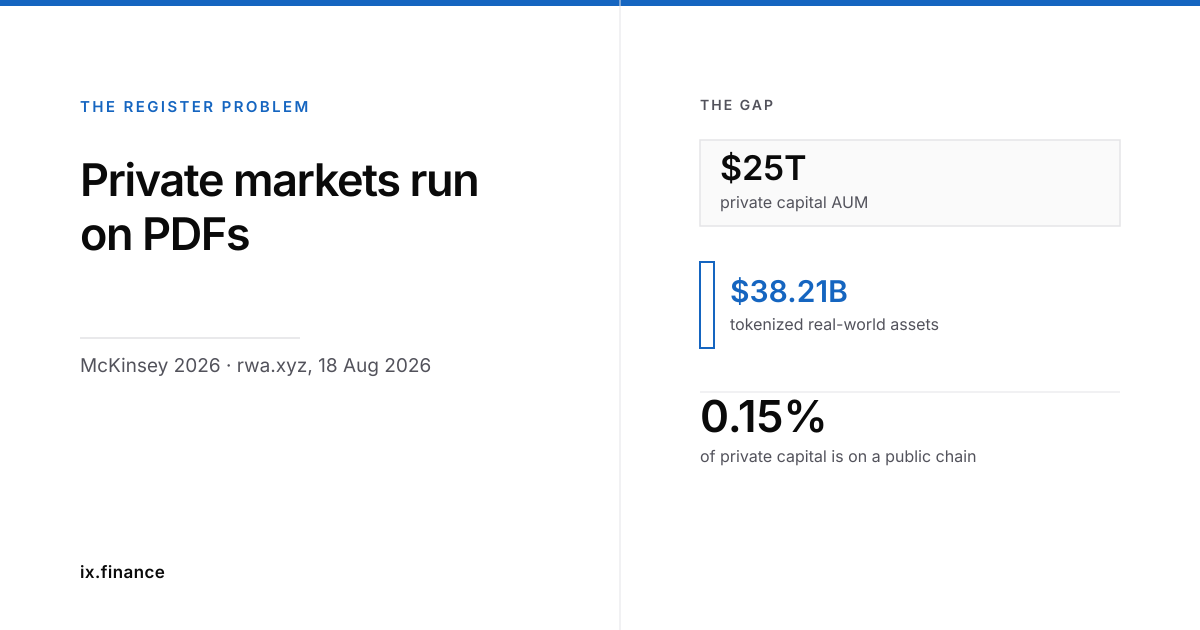 Thesis
Private Markets Run on PDFs: The Ownership Record Problem
Private capital manages close to $25 trillion. Just $38 billion of real-world assets sit on a public chain. The gap is not technology — it is the register.
 Guide
GuideHow to Tokenize an Asset: The Six Steps Nobody Skips
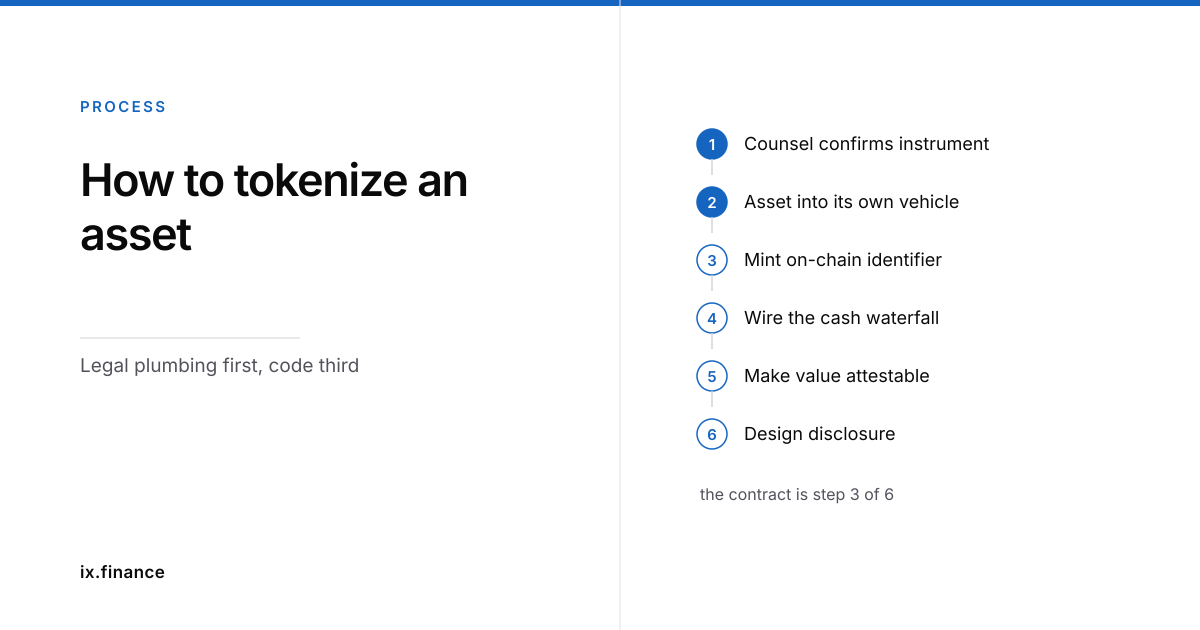
Tokenization is 10% smart contract and 90% legal plumbing. The six steps between a real asset and a claim someone can verify, in the order they must happen.
The register is live.
IX-CORE is the first book on it, running on Base testnet and settling in test tokens. Nothing here is a live financial product.
Open the testnet