What Makes an Asset Worth Tokenizing?
What makes a real-world asset worth tokenizing? Explore the role of ownership, verification, access, settlement, and productive cash flow in RWA tokenization.
Almost anything can be tokenized.
A bond. A building. Gold. A piece of art. A GPU.
Technically, that's the easy part.
The more interesting question is whether putting that asset on-chain actually makes it better.
Because creating a token that points to something in the real world doesn't automatically make that thing more valuable, more useful, or even easier to own. Sometimes tokenization solves a real problem. Sometimes it's just another representation of an asset that worked perfectly well before.
So what makes an asset worth tokenizing?
First, what are we actually changing?
It helps to separate the asset from the surrounding infrastructure.
Take a building.
Tokenizing the building doesn't change the concrete, the location or the tenants. What can change is the way ownership is represented, transferred, divided, recorded and potentially connected to other financial applications.
The same applies to a bond. Or a commodity. Or a piece of infrastructure.
The underlying asset remains real.
What changes is the financial layer around it.
This distinction is becoming more relevant as tokenized assets move beyond small blockchain experiments. RWA.xyz currently tracks around $27.7 billion of distributed tokenized assets, excluding the much larger stablecoin market. Tokenized U.S. Treasuries alone account for roughly $10.9 billion.
The IMF has also started describing tokenization less as a crypto niche and more as a potential change to financial market infrastructure. A tokenized asset can combine ownership records, transfer and payment on programmable ledgers instead of relying on separate systems to handle each step.
That's a much bigger idea than simply splitting an asset into smaller pieces.
Fractional ownership helps. But it isn't the whole story.
Fractionalization is probably the most intuitive benefit of tokenization.
If an asset costs $1 million, most people can't buy it outright. Divide its ownership into smaller units and suddenly participation becomes possible with far less capital.
Useful? Absolutely.
Revolutionary on its own? Not really.
We have been dividing ownership for a long time. Public companies have shares. Real estate funds pool property ownership. ETFs divide exposure to portfolios among millions of investors.
Blockchain didn't invent fractional ownership.
What it can do is combine fractional ownership with something those systems were never originally built around: programmable, digitally native ownership.
A token can potentially carry rules about how it moves, interact with smart contracts, participate in automated settlement and connect to other on-chain financial infrastructure.
That's where tokenization starts becoming more interesting.
Good candidates have ownership that matters
For tokenization to be useful, the token needs to represent something meaningful.
That sounds obvious, but it's important.
Imagine tokenizing a random physical object worth $50.
We could create one million blockchain tokens representing fractions of it. The blockchain could record those tokens perfectly.
But why?
There is probably no meaningful ownership problem to solve. No substantial barrier to entry. No useful income to distribute. No market that becomes dramatically more efficient because the object now exists on-chain.
The technology works.
The economics don't justify it.
Now consider an asset where ownership is expensive, difficult to divide, administratively complex or inaccessible to smaller participants.
The equation changes.
Tokenization becomes more useful when improving the ownership layer creates actual economic value.
Verification matters even more
There is another requirement that becomes increasingly important with real-world assets.
The asset exists outside the blockchain. A blockchain can tell you that Wallet A owns Token A. It cannot, by itself, tell you that the warehouse, Treasury bill, apartment or GPU represented by Token A actually exists. That connection has to be established.
This is one of the fundamental differences between crypto-native assets and RWAs.
With Bitcoin, the asset and its ownership record exist in the same system.
With a tokenized real-world asset, there are two worlds:
the record on-chain
and
the asset off-chain
Good RWA infrastructure has to connect them.
That means questions such as asset identification, custody, valuation and ownership aren't side issues. They're part of what makes the token meaningful in the first place.
The better the connection between the digital representation and the underlying asset, the more useful tokenization becomes.
Assets that produce something are particularly interesting
There is another category that we think deserves more attention: productive assets.
Some assets are primarily held because their owners hope somebody will buy them for more later.
Others produce economic value while they are owned.
A property can generate rent. A Treasury bill generates interest.
Energy infrastructure can generate revenue from producing and distributing power.
A GPU can earn revenue by providing compute.
Once an asset produces cash flow, tokenization isn't only about recording who owns it.
Now there is something else to account for:
the economic activity generated by the asset.
Who owned what during a given period?
How much revenue was generated?
How should that revenue be divided?
When was it settled?
Can the ownership and distribution history be verified?
These are financial infrastructure problems, and programmable ownership gives us new ways to approach them.
This is one reason productive RWAs are especially interesting to us at IX.
Tokenization can also change how assets move
Traditional financial markets contain a surprising amount of plumbing.
Trading, clearing, settlement, custody and recordkeeping often happen across different systems and different organizations.
That infrastructure works. It has also been built in layers over decades.
Tokenized systems offer a different model.
The Bank for International Settlements has highlighted the potential for tokenized assets and money to exist on programmable platforms where information and value can move together. In some designs, the asset and payment can settle simultaneously rather than requiring separate reconciliation afterward.
Again, that doesn't mean every traditional system should be replaced by a blockchain.
It means tokenization becomes valuable when the new infrastructure genuinely reduces friction.
If moving an asset on-chain doesn't improve access, settlement, ownership, programmability, transparency or some other part of its lifecycle, the obvious question is:
Why tokenize it at all?
And no, tokenization doesn't fix a bad asset
This may be the simplest rule of all.
A tokenized bad investment is still a bad investment. Tokenization can't manufacture demand for an asset. It can't turn poor economics into good economics. It doesn't guarantee liquidity. It doesn't make an asset productive if nobody wants what that asset produces.
The underlying fundamentals still matter.
In fact, as tokenization becomes easier, this distinction will probably become more important.
The novelty of putting an asset on-chain will fade.
Eventually, “this asset is tokenized” may be about as interesting as saying “this bank has a mobile app.”
What will matter is what sits underneath.
So, what makes an asset worth tokenizing?
There isn't one universal checklist, but there are some useful questions.
Does ownership matter enough that making it easier to record or divide creates value?
Is the underlying asset identifiable and verifiable?
Does tokenization improve access?
Can it make settlement or transfers more efficient?
Is there useful economic activity that can be connected to ownership?
Can programmable infrastructure do something that the existing ownership system cannot do easily?
And perhaps most importantly:
Would anyone care about this asset if the token didn't exist?
If the answer to that last question is no, putting it on a blockchain probably isn't going to save it.
The RWA market is growing because the opposite is increasingly possible.
Assets that already have value, demand and economic purpose can gain a new ownership layer.
At IX, that's the part of tokenization we're interested in.
Not putting things on-chain simply because we can.
But finding productive assets where on-chain ownership actually makes sense.
Q&A
What does it mean to tokenize a real-world asset?
Tokenization means representing ownership or economic rights to a real-world asset on a blockchain through digital tokens.
What types of assets are best suited for tokenization?
Assets tend to be stronger candidates when tokenization can improve access, ownership, settlement, verification, or the distribution of economic value.
Does tokenization automatically make an asset liquid?
No. Tokenization can make ownership easier to transfer, but real liquidity still depends on actual buyers, sellers, market depth, and demand.
Why are productive assets interesting for tokenization?
Because they can generate economic value while they are owned. Tokenization can help connect that revenue to transparent ownership, accounting, and distribution.
Keep reading
All posts →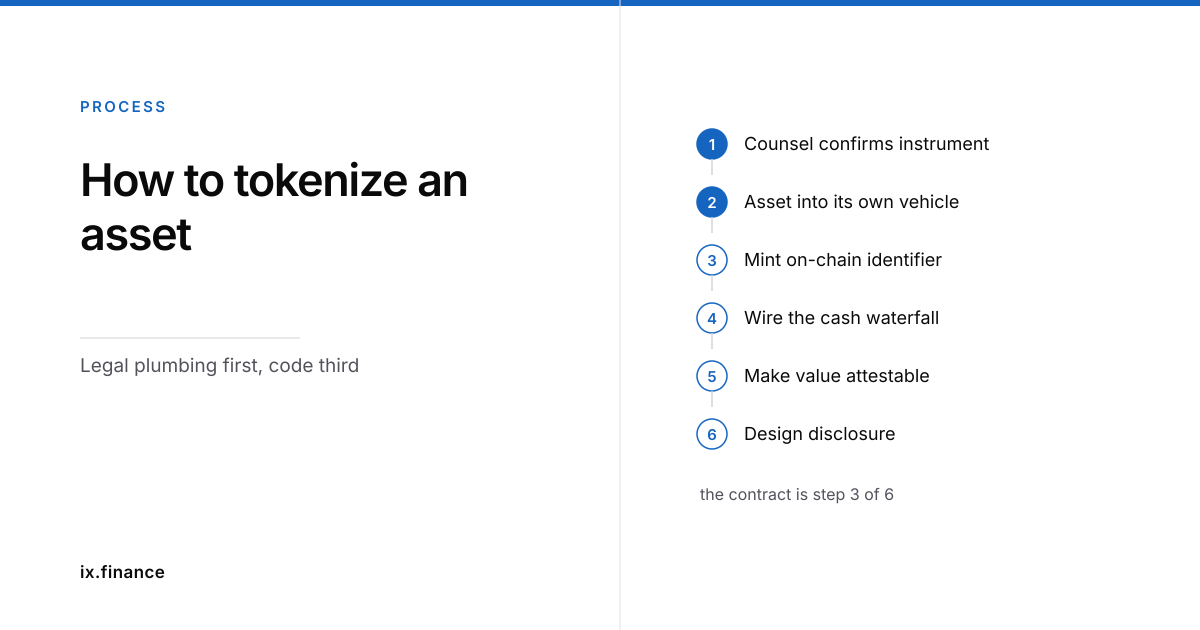 Guide
GuideHow to Tokenize an Asset: The Six Steps Nobody Skips
Tokenization is 10% smart contract and 90% legal plumbing. The six steps between a real asset and a claim someone can verify, in the order they must happen.
 Thesis
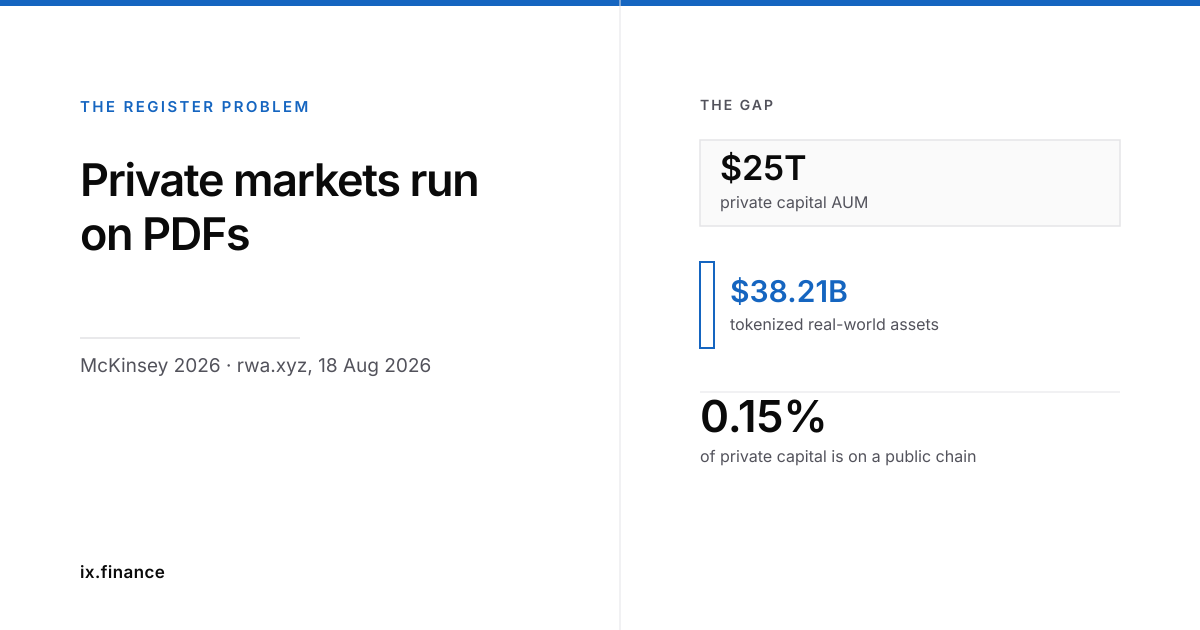
Private Markets Run on PDFs: The Ownership Record Problem
Private capital manages close to $25 trillion. Just $38 billion of real-world assets sit on a public chain. The gap is not technology — it is the register.
The register is live.
IX-CORE is the first book on it, running on Base testnet and settling in test tokens. Nothing here is a live financial product.
Open the testnet