Borrowing Against Illiquid Assets: Collateral Without Selling
NAV lending has grown to an estimated $100-150 billion outstanding. How borrowing against private assets works, what LTVs apply, and where the risk hides.
There's a third option between holding an illiquid asset and selling it: borrow against it.
Homeowners have done this forever. The land registry says you own the house, so a bank will lend against it without you moving out. The register makes the collateral legible, and legible collateral gets credit.
Private markets are catching up, but the mechanics are rougher — because the register underneath is a private document rather than a public fact.
Key takeaways
- NAV financing is estimated at $100-150 billion outstanding, with projections of $600-700 billion by 2030 (Callan; Termgrid).
- Typical loan-to-value ratios run 10-25% of portfolio value — conservative by design.
- The collateral is a valuation the borrower influences, which is why the FCA named secured borrowing as a conflict area.
- Lending against a claim requires the claim to be verifiable first. That order can't be reversed.
What does borrowing against an illiquid asset mean?
It means pledging an asset you can't easily sell as security for a loan, and keeping the asset's upside while you use the cash. In private markets the most developed form is NAV financing: a loan to a fund or its manager, secured against the fund's portfolio.
Industry estimates put NAV financing at $100-150 billion outstanding, with projections reaching $600-700 billion by 2030 (Callan, NAV Loan Lenders: What Private Credit Investors Should Know; Termgrid, NAV lending and GP financing become core tools for private equity). Deal sizes have grown sharply — average European deal size rose from roughly €330 million in 2023 to €800 million in 2024 — and in March 2026, 17Capital closed a $7.5 billion NAV-focused credit fund, the largest such raise recorded.
The structure differs from a subscription line, which is worth distinguishing because they're often confused.
| Subscription line | NAV loan | |
|---|---|---|
| Secured against | LP commitments not yet called | The fund's actual portfolio |
| When used | Early in fund life | Mid to late fund life |
| Recourse | Investors' obligation to fund | Portfolio value |
| Risk driver | Investor creditworthiness | Asset valuation |
The second column is the one that behaves badly in a downturn, because its collateral is a mark rather than a contractual obligation.
Why borrow instead of selling?
Because selling crystallises a price at the worst possible moment and gives up the recovery. The reasons managers borrow rather than sell are mostly about timing.
- Fund the next round. A portfolio company needs capital and the fund is out of dry powder.
- Generate distributions. Investors want cash back, exits are slow, and borrowing bridges the gap.
- Avoid a discount sale. Secondary pricing may be well below the manager's view of value.
- Keep the upside. Selling at 80% of NAV forfeits the remaining 20% plus future growth.
That third motive deserves scrutiny. When secondary pricing sits meaningfully below reported NAV, a manager faces a choice: accept the market's verdict, or borrow against their own mark and wait. Borrowing is often the right call. It's also, sometimes, a way to avoid testing a valuation. How illiquid assets are valued explains why that test matters, and secondary pricing is usually the sharper signal of the two.
What loan-to-value can you get?
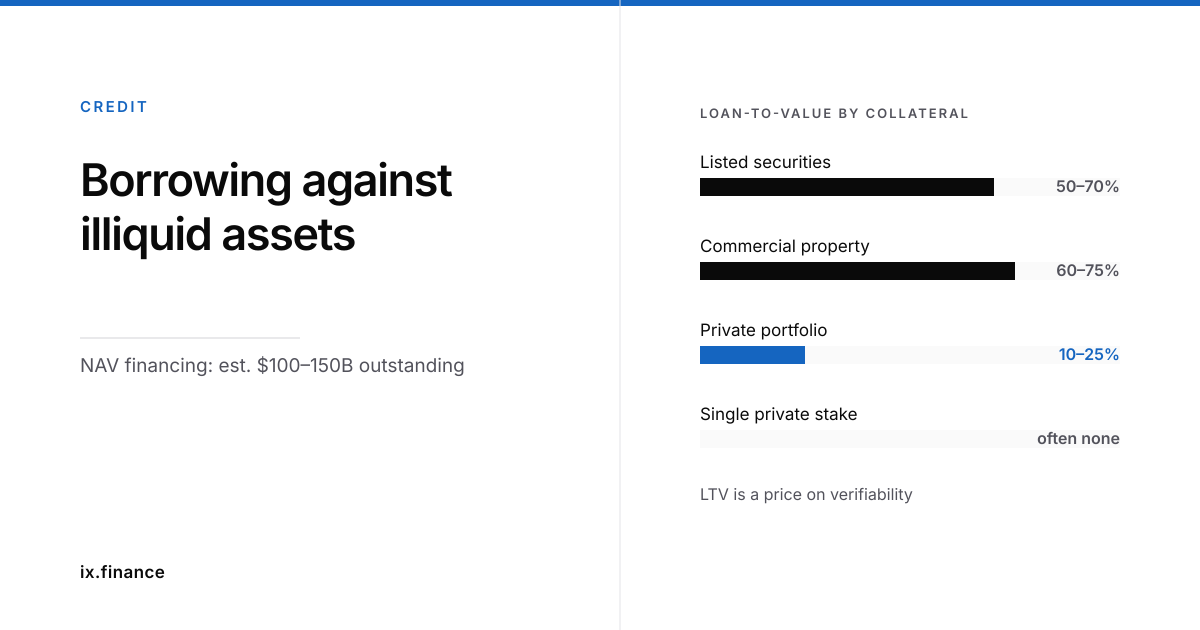
Low. Typical NAV loan LTVs run between 10% and 25% of portfolio value — far below the 70-80% a lender would advance against a stabilised commercial property.
The gap between those numbers is entirely about collateral quality:
| Collateral | Typical LTV | Why |
|---|---|---|
| Listed securities | 50-70% | Daily price, immediate sale |
| Commercial property | 60-75% | Public title, active market, appraisals |
| Diversified private portfolio | 10-25% | Estimated value, slow enforcement |
| Single private stake | Often unfinanceable | No comparables, consent needed to transfer |
Read that as a price list for verifiability. The more independently checkable the collateral, the more credit it supports. A private portfolio gets 10-25% not because the assets are bad, but because the lender can't confirm value independently, can't sell quickly, and may need consents to enforce at all.
The LTV a lender offers is a direct measure of how much they trust your ownership record and your valuation. If the answer is 15% on quality assets, the constraint isn't the assets — it's the paperwork around them.
Where does the risk actually sit?
In the collateral value being an estimate produced by a party with an interest in it being high. This is the structural weakness of the whole category, and supervisors have said so directly.
The FCA's multi-firm review of private market valuation practices, published 5 March 2025, listed the areas where conflicts are most likely to arise — and secured borrowing was among them, alongside investor fees, asset transfers, redemptions and subscriptions (Financial Conduct Authority, Private market valuation practices, March 2025). The reason is mechanical: if a higher mark supports a larger loan, there's pressure on the mark.
Then there's layering. The IMF has flagged multiple layers of leverage in private markets as a systemic vulnerability, and the Financial Stability Board dedicated a report to private credit weaknesses in May 2026 (FSB, Report on Vulnerabilities in Private Credit, 6 May 2026). Consider how the layers stack:
- The portfolio company borrows.
- The fund borrows against the portfolio.
- The investor may borrow to meet its commitment.
Each layer is defensible alone. Together they mean a moderate fall in asset values produces a much larger fall in equity — and nobody outside the structure can see the total.
Can on-chain claims be better collateral?
Only if the claim is verifiable and the valuation is attested. Otherwise you've moved the same trust problem to a different database.
A genuinely better collateral primitive needs four properties, in this order:
| Requirement | Why it comes first |
|---|---|
| Verifiable ownership | The lender must confirm the pledge without asking the borrower |
| Attested valuation | Inputs signed by parties who don't profit from the number |
| Enforceable security | A path to the asset in the vehicle if the loan defaults |
| Liquidation assumption | Rules that assume value can fall, and fall fast |
Get those and the LTV question changes, because the lender's uncertainty is smaller. Skip them and you have a fast, automated way to make an over-marked loan.
This is why credit is the last piece rather than the first. IX Credit is designed and not built — 0% implemented — and that sequencing is deliberate. A credit system without a risk engine, a reserve, and a NAV that can be independently checked is a structure that works until it doesn't. Physical asset values fall when day-rates fall and hardware depreciates; private credit values fall when borrowers miss. Any lending design that assumes NAV only rises is mispriced from the start.
The precondition is a register where the claim is checkable, which is the whole argument in the ownership record problem. Until that exists, lending against a private claim means trusting the borrower's own paperwork — and pricing accordingly, which is exactly what a 15% LTV represents.
Frequently asked questions
Can an individual borrow against private company shares?
Sometimes, through specialist lenders, at low LTVs and high rates. The barriers are transfer restrictions in the shareholders' agreement, absence of a market price, and the difficulty of enforcing against a minority stake. Many lenders decline single-company collateral outright.
Does borrowing against a portfolio increase risk for investors?
Yes. A NAV loan adds leverage at fund level, which amplifies both returns and losses, and its interest is paid before distributions. Whether that's an acceptable trade depends on the LTV, the purpose and whether investors were told clearly.
What happens on default?
The lender enforces against the pledged interests, which in private markets can mean stepping into fund positions subject to transfer restrictions and manager consent. Enforcement is slow and negotiated, which is precisely why LTVs stay conservative.
Is this the same as crypto lending against tokens?
The mechanics rhyme; the collateral doesn't. Liquid tokens have continuous prices and instant liquidation. A tokenized private asset has an estimated value and no ready buyer, so the same automated liquidation logic would misfire badly. Assuming otherwise is how lending books break.
The short version
Borrowing against illiquid assets solves a genuine problem: needing cash without selling at the wrong moment. The market has grown quickly, and conservative LTVs show lenders understand what they're securing.
The constraint is the same one running through all of private markets. Credit is priced off a record and a valuation the borrower controls. Fix the record first, and the lending gets cheaper on its own.
This post closes a ten-part series on private markets on-chain. It starts with the ownership record problem.
Sources
- Callan, NAV Loan Lenders: What Private Credit Investors Should Know, retrieved 2026-08-27 — https://www.callan.com/blog/nav-loan-lenders/
- Termgrid, NAV lending and GP financing become core tools for private equity, retrieved 2026-08-27 — https://app.termgrid.com/article/nav-lending-gp-financing-private-equity/
- Financial Conduct Authority, Private market valuation practices, 5 March 2025, retrieved 2026-08-27 — https://www.fca.org.uk/publications/multi-firm-reviews/private-market-valuation-practices
- Financial Stability Board, Report on Vulnerabilities in Private Credit, 6 May 2026, retrieved 2026-08-27 — https://www.fsb.org/uploads/P060526.pdf
Keep reading
All posts →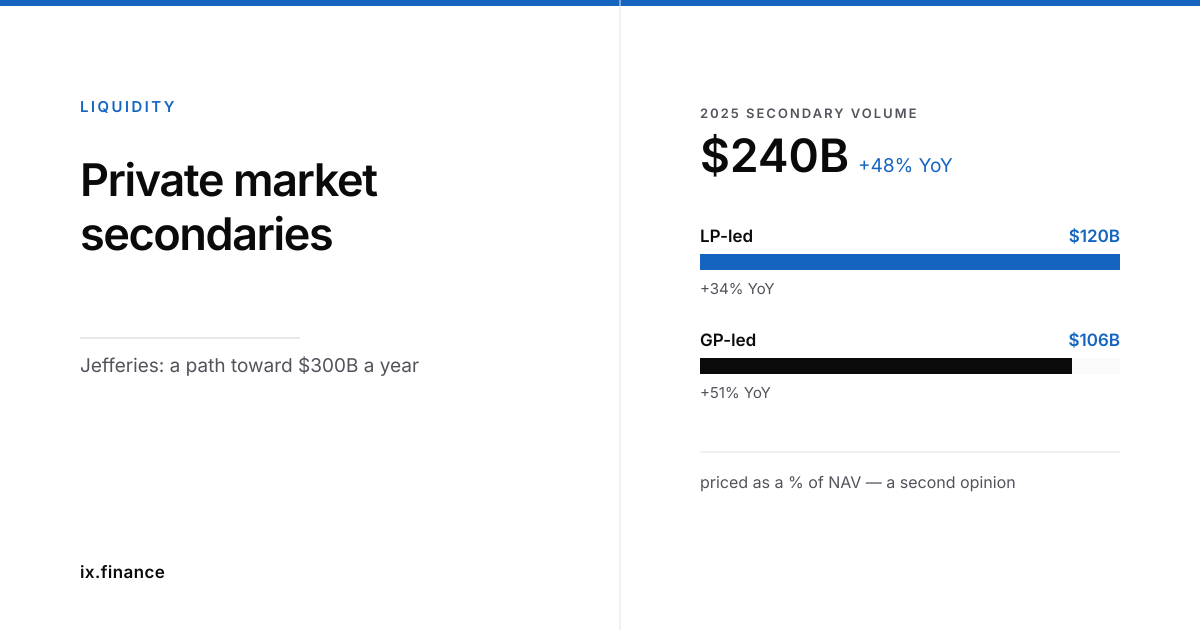 Explainer
Private Market Secondaries: How Investors Exit Before the Exit
Secondary volume hit $240 billion in 2025, up 48%. How LP-led and GP-led deals work, how stakes get priced against NAV, and what the discount really tells you.
 Analysis
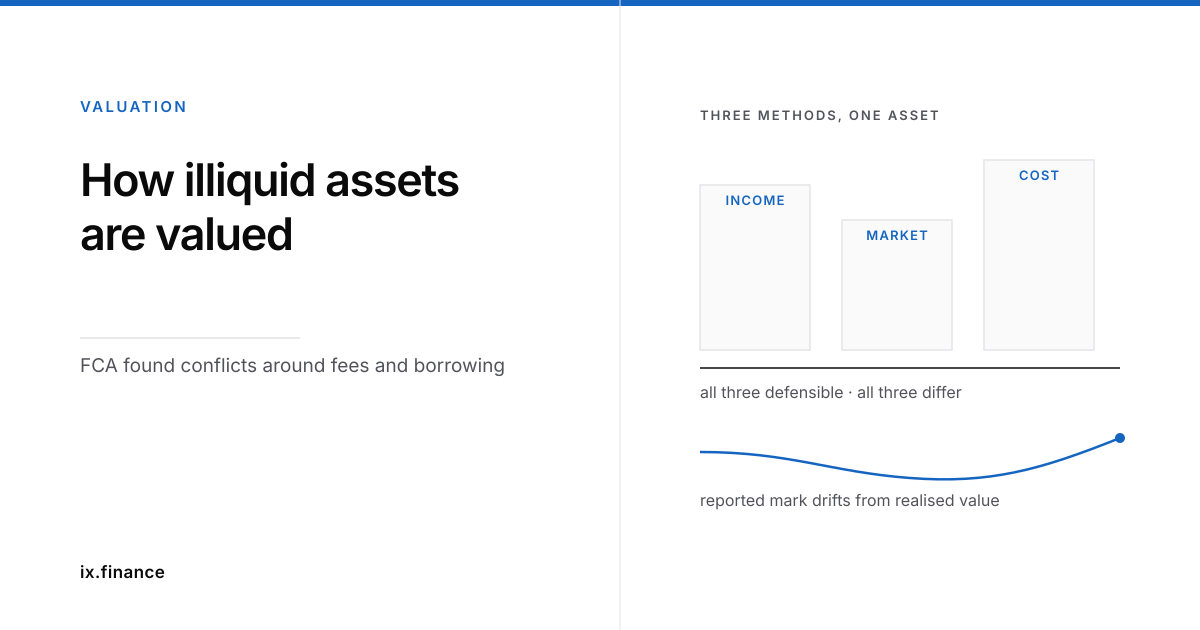
How Illiquid Assets Are Valued — and Why the Marks Drift
Illiquid assets have no price, only an estimate. How NAV is built for private assets, why marks lag reality, and what regulators found when they looked.
The register is live.
IX-CORE is the first book on it, running on Base testnet and settling in test tokens. Nothing here is a live financial product.
Open the testnet