Private Market Secondaries: How Investors Exit Before the Exit
Secondary volume hit $240 billion in 2025, up 48%. How LP-led and GP-led deals work, how stakes get priced against NAV, and what the discount really tells you.
A private equity fund has a ten-year life. Investors who need their capital back in year six have a problem, because there's no sell button.
The secondaries market exists to solve that. Someone buys the existing investor's position — the stake, the remaining commitments, the future distributions — and takes their place in the fund.
It's grown from an awkward last resort into a core piece of market infrastructure, and the pricing it produces is the closest thing private markets have to an honest second opinion.
Key takeaways
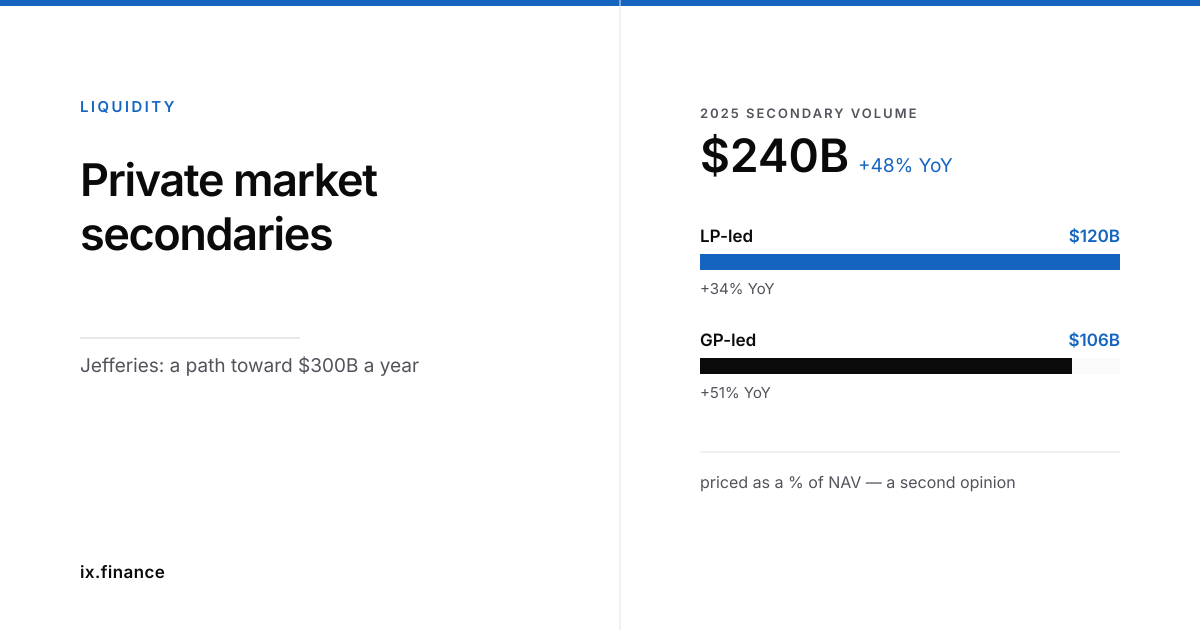
- Secondary volume reached $240 billion in 2025, up 48% year on year (Jefferies, Global Secondary Market Review, January 2026).
- LP-led deals hit $120 billion (+34%); GP-led deals hit $106 billion (+51%).
- Stakes are priced as a percentage of NAV — and the discount is a market verdict on the manager's mark.
- Jefferies sees a path to roughly $300 billion in annual volume within 12 to 24 months.
What is a secondary transaction?
It's the sale of an existing private market interest from one investor to another, mid-life. The asset doesn't move and the fund doesn't wind up — the position changes hands. In 2025 that market set a record: $240 billion of transaction volume, a 48% increase year on year (Jefferies, 2025 Global Secondary Market Review, January 2026).
Two structurally different transactions get grouped under the label.
| LP-led | GP-led | |
|---|---|---|
| Who initiates | An existing investor | The fund manager |
| What is sold | One investor's stake | One or more assets, into a new vehicle |
| Motive | Liquidity, rebalancing, portfolio pruning | Extended hold, DPI generation |
| 2025 volume | $120 billion (+34%) | $106 billion (+51%) |
| Typical form | Stake purchase | Continuation fund |
GP-led is the faster-growing half, and it's the one that carries a conflict worth naming — the manager is often on both sides of the pricing conversation.
Why does anyone sell early at a discount?
Because a discount today can be worth more than par in four years. The reasons are mostly portfolio mechanics rather than distress.
- Denominator effect. Public markets fall, private allocations breach their target weight, and something has to be sold.
- Distribution drought. Exits slow, capital doesn't come back, and new commitments still have to be funded.
- Portfolio cleanup. Trimming tail-end funds and consolidating manager relationships.
- Genuine liquidity need. An endowment, insurer or family office with an obligation to meet.
Notice that none of those are "this fund is bad." Most secondary supply is a rebalancing decision, which is why buyers can find quality at a discount without assuming they're buying somebody's mistake.
How is a private stake priced?
As a percentage of the manager's last reported NAV — and that percentage is the whole negotiation. A stake at "92% of NAV" means the buyer thinks the mark is roughly right and wants compensation for illiquidity and time. At 70%, the buyer disagrees with the mark.
The buyer's work is essentially re-underwriting:
- Take the reported NAV as a starting point, not a fact.
- Re-value the largest holdings using their own assumptions.
- Adjust for lag — the mark may be several months stale.
- Model the remaining life, including unfunded commitments.
- Apply a required return on the capital deployed.
- Quote a percentage of NAV that delivers it.
This is why secondary pricing is such a useful cross-check. Reported NAV is produced by the party earning fees on it; secondary pricing is produced by someone spending their own money. When the two diverge persistently, the divergence is information — and it lines up with what we covered in how illiquid assets are valued.
If you hold private fund interests, ask what similar stakes have traded at recently. It's the cheapest reality check available on your own reported returns — and it costs nothing but a phone call to a placement agent.
What is a continuation fund?
It's a new vehicle raised by the same manager to buy assets out of an older fund it also manages. Existing investors choose: take cash, or roll into the new vehicle on new terms.
The legitimate case is real. A strong asset may need three more years and more capital than the original fund can provide, while investors in a fund at the end of its life need an exit. A continuation vehicle serves both.
The conflict is equally real. The manager influences the price at which it sells to itself, and earns fees on both sides. Regulators have been paying attention to precisely this class of transaction — the FCA's March 2025 review of private market valuation practices identified conflicts around asset transfers, investor fees, subscriptions and redemptions (Financial Conduct Authority, Private market valuation practices, March 2025).
The questions that matter, in order: Who set the price? Was there a competitive process, or a single bidder? Did an independent adviser opine? What did the fairness opinion actually test?
Why is the market growing so fast?
Because private markets got much larger while exit routes got narrower. Closed-end private capital sits near $16 trillion, with total private capital approaching $25 trillion (McKinsey & Company, Global Private Markets Report 2026, February 2026). A market that size generates continuous liquidity demand regardless of conditions.
Jefferies sees a path to roughly $300 billion in annual volume within 12 to 24 months, with H1 2026 expected to exceed $100 billion on backlog alone. Total capital available to the secondary market — dedicated funds, traditional LPs and leverage — reaches roughly $477 billion.
But there's a structural drag on all of it, and it's the same one that shows up everywhere in private markets: every transfer requires rebuilding a verification picture from scratch. Confirming the seller owns the interest, that nothing sits ahead of it, that the transfer is permitted under the fund documents. Weeks of work on facts that should be queryable.
A register where interests are recorded and independently checkable takes that friction out without publishing anybody's book — the argument in the ownership record problem. Tokenized private equity remains tiny by comparison: the largest single position on rwa.xyz shows $956.8 million against $38.21 billion of total tokenized real-world assets (rwa.xyz, retrieved 18 August 2026).
Frequently asked questions
Can individual investors sell private fund stakes?
Increasingly, though minimum sizes remain high and the process is intermediated. Most secondary buyers focus on institutional-scale positions. Semi-liquid evergreen structures offer periodic redemptions instead, subject to gates and caps.
Does a secondary sale need the manager's consent?
Almost always. Fund documents typically require GP consent for transfers, and the manager may hold rights of first refusal. Consent is usually granted for credible buyers, but it's a real gate rather than a formality.
Is buying at a discount to NAV automatically a good deal?
No. The discount may be correctly pricing an overstated mark. Research indicates reported NAV understates upside among strong performers and overstates value among laggards, so the discount's adequacy depends entirely on which you're buying.
How long does a secondary transaction take?
Typically two to four months for an LP-led deal — diligence, GP consent, documentation and settlement. GP-led continuation vehicles usually take longer because a full fundraise runs alongside the asset transfer.
The short version
Secondaries turned a ten-year lockup into a market. They give investors an exit before the exit, and they give everyone else a price discovered by someone with capital at risk rather than fees at stake.
The remaining cost is verification. Every transfer re-establishes facts a proper register would already hold.
Related reading: private credit, explained, and what an SPV is — the container every one of these interests sits in.
Sources
- Jefferies, 2025 Global Secondary Market Review, January 2026, retrieved 2026-08-26 — https://www.jefferies.com/insights/the-big-picture/2025-global-secondary-market-review-another-record-breaking-year/
- McKinsey & Company, Global Private Markets Report 2026, February 2026, retrieved 2026-08-26 — https://www.mckinsey.com/industries/private-capital/our-insights/global-private-markets-report
- Financial Conduct Authority, Private market valuation practices, 5 March 2025, retrieved 2026-08-26 — https://www.fca.org.uk/publications/multi-firm-reviews/private-market-valuation-practices
- rwa.xyz, Tokenized real-world asset dashboard, retrieved 2026-08-26 — https://app.rwa.xyz/
Keep reading
All posts →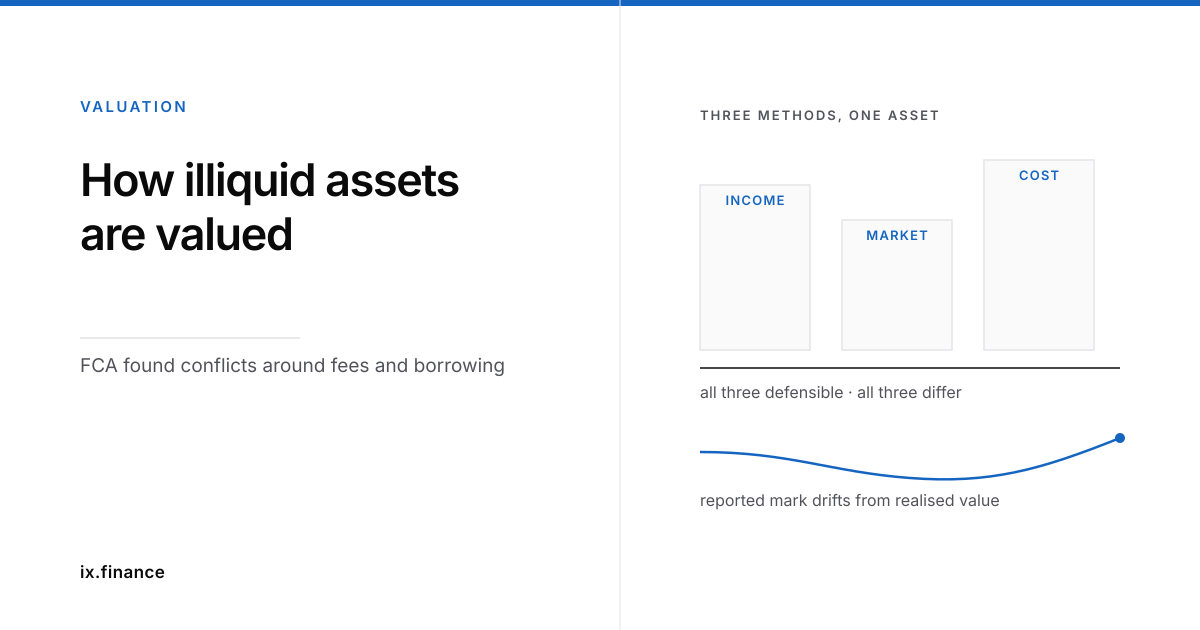 Analysis
How Illiquid Assets Are Valued — and Why the Marks Drift
Illiquid assets have no price, only an estimate. How NAV is built for private assets, why marks lag reality, and what regulators found when they looked.
 Guide
GuideReal Estate Tokenization: How a Property Title Moves On-Chain
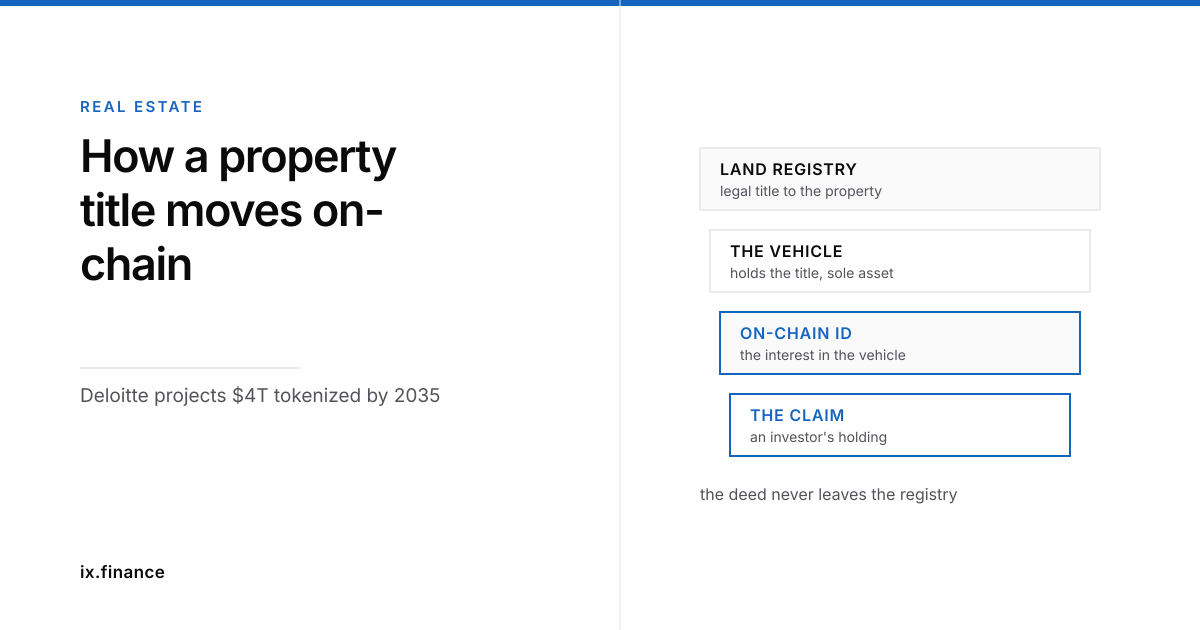
Deloitte projects $4 trillion of tokenized real estate by 2035. Yet the largest on-chain property position today is under $90 million. What explains the gap?
The register is live.
IX-CORE is the first book on it, running on Base testnet and settling in test tokens. Nothing here is a live financial product.
Open the testnet