Real Estate Tokenization: How a Property Title Moves On-Chain
Deloitte projects $4 trillion of tokenized real estate by 2035. Yet the largest on-chain property position today is under $90 million. What explains the gap?
Real estate is the most-discussed tokenization use case and one of the least delivered. The pitch writes itself: a building is valuable, illiquid, income-producing and expensive to divide. Put it on-chain and any of those problems improve.
The forecasts are large. Deloitte's Center for Financial Services projects $4 trillion of tokenized real estate by 2035, up from under $0.3 trillion in 2024 — a 27% compound growth rate (Deloitte Insights, April 2025).
The present is smaller. The largest single tokenized real estate position visible on rwa.xyz shows $89.9 million (rwa.xyz, retrieved 18 August 2026). So what's actually in the way?
Key takeaways
- Deloitte projects $4 trillion of tokenized real estate by 2035, from under $0.3 trillion in 2024.
- Tokenized debt securities are expected to dominate that figure at $2.39 trillion — debt, not equity in buildings.
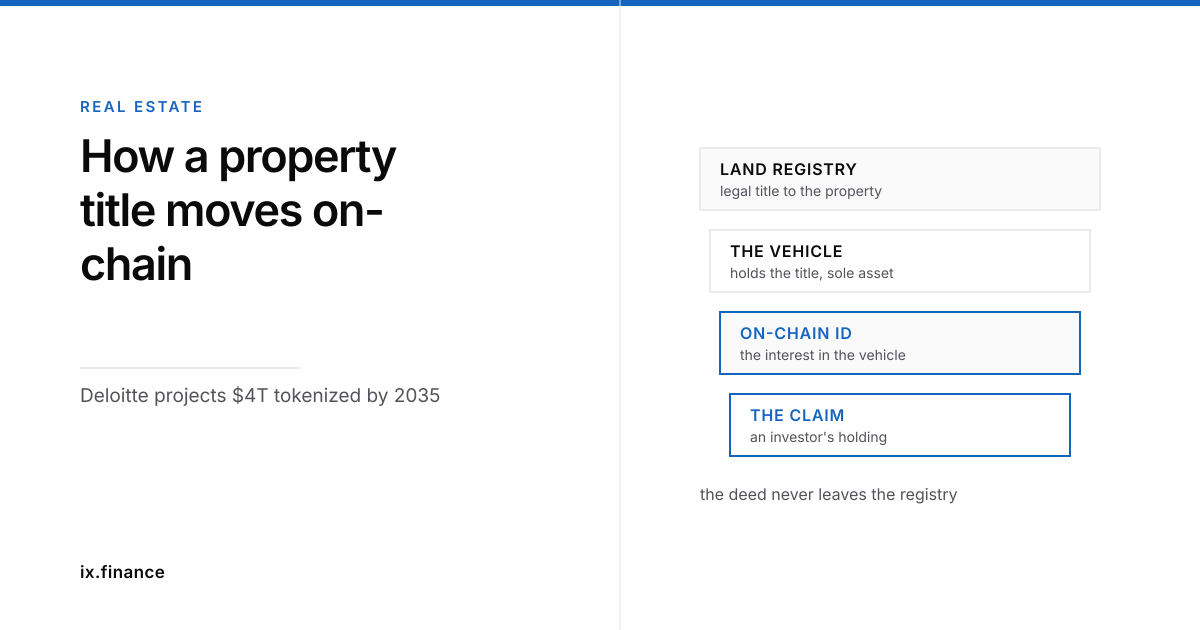
- Title stays in a land registry; the token records an interest in the vehicle that holds it.
- The blockers are jurisdictional title law, confidentiality of lease terms, and valuation — not the contract.
What actually gets tokenized — the building or the company?
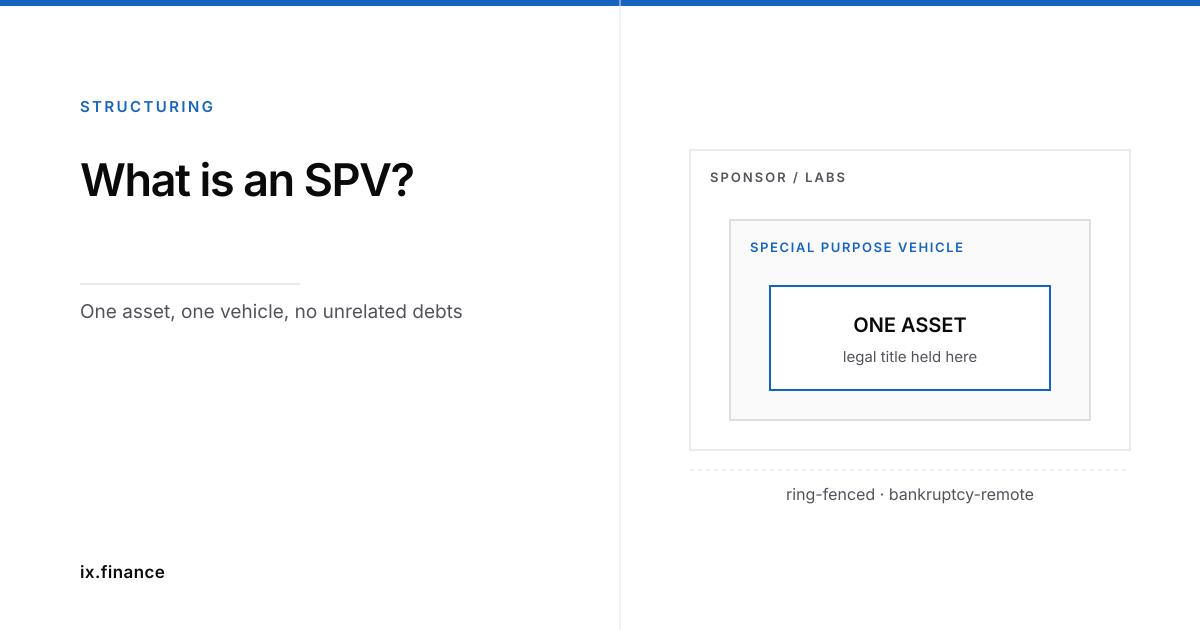
The company. A land registry records title to real property, and no blockchain overrides it. So the structure puts the property into a vehicle, and the on-chain record tracks interests in that vehicle.
The chain of ownership looks like this:
| Layer | What holds it | Where it is recorded |
|---|---|---|
| The building | Legal title | National or municipal land registry |
| The vehicle | The title, as sole asset | Corporate registry |
| The interest | Shares or units in the vehicle | On-chain identifier |
| The claim | An investor's holding | The register, ideally sealed |
Every honest structure looks like this. The registry stays authoritative for the property itself, which is why the phrase "the deed is on the blockchain" is a warning sign rather than a feature — the deed is where the law says it is.
If the vehicle layer is unfamiliar, what an SPV is covers why one asset per vehicle is the standing rule.
What are the actual steps?
The same six as any private asset, with two property-specific complications. The full sequence is in how to tokenize an asset; here's what changes for real estate.
- Counsel confirms the instrument — usually shares in a property-holding vehicle, occasionally a beneficial interest under trust.
- The vehicle is formed in a jurisdiction that recognises the structure and permits foreign holders.
- Title is transferred into the vehicle — the step that involves stamp duty, land registry filings and real elapsed time.
- The on-chain identifier is minted, referencing the vehicle and the valuation method.
- The rent waterfall is wired — property management, reserves, debt service, then distribution.
- Disclosure is designed — because lease terms and tenant identities are commercially sensitive.
Step three is where most projects stop. Transferring title triggers transaction taxes in most jurisdictions, sometimes a substantial percentage of value. Some structures avoid the trigger by transferring the vehicle rather than the property — which only works if the property was already inside a vehicle before the deal.
Transfer taxes are a real cost of getting a property into a vehicle, and they're paid in cash before a single token exists. Any model that ignores them is understating the cost of entry — and it's the reason most credible structures start with property that's already held in a company.
Why has adoption been so slow?
Three reasons, and only one of them is technical.
Title law is jurisdictional and unforgiving. Every country's land registry has its own rules on who may hold property, what must be filed and how disputes resolve. There's no global title system to point a contract at. A structure that works in Dubai needs redesigning for Germany.
Lease terms are confidential. A commercial landlord doesn't want tenant identities, rent levels, incentive packages and break options published to competitors and to every tenant negotiating a renewal. On a transparent chain, that's exactly what happens. This is the general problem set out in why institutions won't put private assets on a public blockchain.
Valuation is periodic and contested. A building is appraised occasionally, by a valuer engaged by the owner. That's a defensible estimate, not a price — and it becomes the number that drives redemptions, fees and borrowing. The FCA's March 2025 review found conflicts concentrated around exactly those pressure points (Financial Conduct Authority, Private market valuation practices, March 2025), and we unpacked the mechanics in how illiquid assets are valued.
Note which of those a smart contract fixes. None.
Does tokenized property actually become liquid?
Not automatically. Divisibility is not liquidity — a stake being technically transferable doesn't produce someone willing to buy it at a fair price on a Tuesday.
Liquidity needs four things, and tokenization delivers one:
| Requirement | Does tokenization provide it? |
|---|---|
| Divisible units | Yes |
| A defensible, current valuation | No — needs attested inputs |
| Verifiable ownership | Only with a proper register |
| Willing buyers at scale | No — needs a market |
The honest version of the promise is narrower and still worth having: tokenization removes the administrative friction from transfer, so that when a buyer does exist, the transaction takes days instead of months. That's meaningful. It isn't the same as a listed REIT.
Deloitte's own breakdown supports the narrower reading. Of the projected $4 trillion, tokenized debt securities account for $2.39 trillion, with private funds around $1 trillion and land development roughly $500 billion. The largest component is property debt — contractual, with observable payment terms — rather than fractional equity in individual buildings. That matches which assets tokenize well: contractual cash flow beats appraised value every time.
What does a credible property structure look like?
Boring, documented and specific. The questions worth asking, and the answers that should come back immediately:
- Which registry holds title, and what document transferred it into the vehicle?
- What was the transfer date, and were transaction taxes paid?
- Who values the property, how often, and who selected the valuer?
- Where does rent land, and in what order does it leave?
- What is disclosed publicly, and what stays sealed?
- If the sponsor fails, what happens to the property?
A sponsor who answers those in a minute has done the work. A sponsor who redirects to the technology has not.
At IX Finance, real estate is one of four books on the same rail — and it's not live. The only live book is AI infrastructure, on Base testnet, with settlement in test tokens. Property sits behind the same requirements as everything else: title in a vehicle, a wired waterfall, attested valuation inputs, and a sealed-claim format that is currently specified rather than built.
Frequently asked questions
Can I own part of a house through a token?
Legally you'd own part of a company that owns the house, with rights defined by that company's documents rather than by property law directly. The distinction matters for control, taxation and what happens in a dispute.
Is tokenized real estate a security?
Usually yes. An interest in a vehicle that holds income-producing property, sold to passive investors, has the characteristics regulators treat as a security in most jurisdictions. Structures marketed as exempt deserve close reading of the exemption claimed.
How is rent distributed to token holders?
Rent is collected by the vehicle, which pays management costs, reserves and any debt service first. What remains is distributed pro-rata. The order is set in the vehicle's documents, and holders sit last.
What happens if the property is sold?
The vehicle sells the asset, settles liabilities and distributes proceeds to holders according to the waterfall. Token holders don't sell the building directly — they hold interests in the entity that does.
The short version
Real estate tokenization works when the property is already in a vehicle, the valuation rests on observable inputs, and confidential lease terms can stay confidential.
The projections point at property debt more than fractional buildings, and that's the tell. Contractual cash flow tokenizes cleanly. Appraised equity in a single building does not.
Related reading: what fractional ownership means, and private credit, explained.
Sources
- Deloitte Center for Financial Services, Tokenized real estate, 24 April 2025, retrieved 2026-08-25 — https://www.deloitte.com/us/en/insights/industry/financial-services/financial-services-industry-predictions/2025/tokenized-real-estate.html
- rwa.xyz, Tokenized real-world asset dashboard, retrieved 2026-08-25 — https://app.rwa.xyz/
- Financial Conduct Authority, Private market valuation practices, 5 March 2025, retrieved 2026-08-25 — https://www.fca.org.uk/publications/multi-firm-reviews/private-market-valuation-practices
Keep reading
All posts →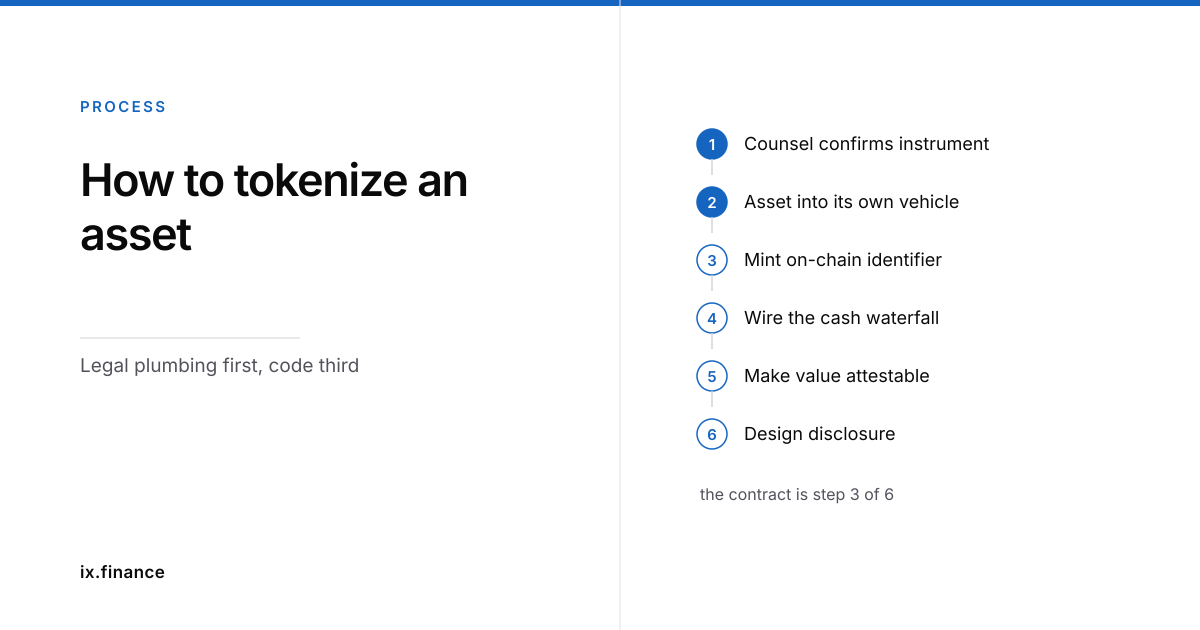 Guide
GuideHow to Tokenize an Asset: The Six Steps Nobody Skips
Tokenization is 10% smart contract and 90% legal plumbing. The six steps between a real asset and a claim someone can verify, in the order they must happen.
 Explainer
What Is an SPV? Special Purpose Vehicles in Plain English
A special purpose vehicle holds one asset and nothing else. Here is why almost every private deal uses one, what bankruptcy-remote means, and how SPVs fail.
The register is live.
IX-CORE is the first book on it, running on Base testnet and settling in test tokens. Nothing here is a live financial product.
Open the testnet