Why Institutions Won't Put Private Assets on a Public Blockchain
A public ledger publishes your book to competitors. That single fact explains why $25 trillion of private capital has stayed off-chain while Treasuries moved.
Ask a private credit CIO why their loan book isn't on a blockchain and you won't get a lecture about gas fees or throughput. You'll get one sentence: I'm not publishing my borrowers.
That's the whole objection. Everything else — custody, regulation, integration — is solvable with money and time. Publishing a confidential book to competitors is not a problem you solve with better engineering, because transparency is the feature the technology was built around.
It's worth taking the objection seriously rather than treating it as reluctance to modernise.
Key takeaways
- Public chains publish position sizes, counterparties and timing by default — commercially unusable for a confidential book.
- Tokenized real-world assets total $38.21 billion (rwa.xyz, August 2026) and cluster in categories with no confidentiality requirement.
- Permissioned chains restore privacy but reintroduce operator trust and lose composability.
- The unlock is proof without disclosure, not more disclosure.
What exactly gets exposed?
Everything an indexer can read, which on a transparent chain is everything. Tokenized real-world assets reached $38.21 billion by 18 August 2026, with 2,097,268 holders (rwa.xyz, retrieved 18 August 2026) — and the categories that dominate that figure are precisely the ones with nothing to hide.
Put a real private book on a transparent ledger and here's what becomes public:
| What is visible | Who benefits from seeing it |
|---|---|
| Facility size per borrower | Competing lenders pricing the next deal |
| Timing of drawdowns | The borrower's suppliers and customers |
| Concentration across the portfolio | Competitors, and anyone shorting the sector |
| Holder addresses and position sizes | Anyone mapping your investor base |
| Redemption activity | Counterparties reading distress into outflows |
None of that is a privacy nicety. A lender who reveals facility sizes has handed rivals their pricing grid. A fund whose redemptions are watchable in real time has given the market a run indicator.
Isn't this just conservatism?
No — and the pattern in the data settles it. If institutional hesitancy were cultural, adoption would be uniformly slow. Instead it's sharply uneven, and it splits exactly along the confidentiality line.
Look at what moved on-chain first. Treasury products, money market funds and gold: instruments with public pricing, a functioning register and no commercial secret in the position. On rwa.xyz the largest tokenized gold position sits at $2.7 billion, while the largest single tokenized real estate position shows $89.9 million.
Real estate is a vastly larger asset class than gold. It has adopted far less. The difference isn't enthusiasm — it's that a property's tenant terms and debt stack are confidential, and a gold bar's aren't.
The adoption curve is a confidentiality curve. Assets with no secret to keep tokenized first and fastest. That's not a coincidence, and it predicts what happens next: the categories still waiting are the ones that need sealing, not the ones that need marketing.
Why not just use a private chain?
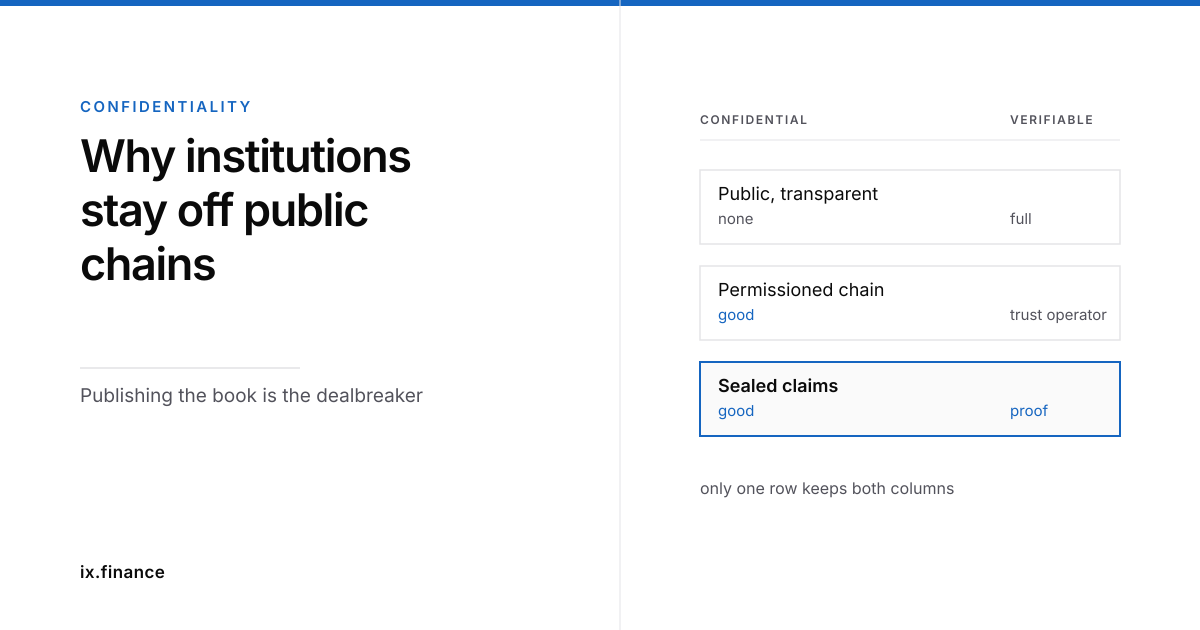
Because a permissioned chain solves confidentiality by reintroducing the problem it was meant to remove: trusting the operator. If one consortium runs the validators, participants are back to relying on that consortium's honesty and continuity — the same position they were in with a fund administrator's database, but with more infrastructure to maintain.
The three-way trade-off is stark:
| Approach | Confidentiality | Verifiability | Composability |
|---|---|---|---|
| Public chain, transparent | None | Anyone can check | Full |
| Permissioned chain | Good | Trust the operator | Minimal |
| Public chain, sealed claims | Good | Proof, without disclosure | Full |
Most enterprise blockchain efforts of the last decade picked row two and quietly discovered the third column mattered. A ledger nothing else can connect to is a database with a consensus algorithm attached — and the whole point of a shared register is that other systems can point at it.
This is the same structural bind we described in the ownership record problem: checkable and confidential have been mutually exclusive, and private markets need both.
Doesn't regulation require disclosure anyway?
Regulation requires disclosure to specific parties, which is a completely different requirement from publication to everyone. That distinction is where the solution lives.
Supervisors have been clear that opacity in private markets is a concern. The IMF has flagged stale valuations, layered leverage and unclear interlinkages in private credit, and the Financial Stability Board published a dedicated report on private credit vulnerabilities in May 2026 (FSB, Report on Vulnerabilities in Private Credit, 6 May 2026). The FCA's March 2025 valuation review pushed for better documentation and independence (Financial Conduct Authority, Private market valuation practices, March 2025).
Read carefully, none of that asks managers to broadcast their book. What supervisors want is reliable answers to targeted questions: is this solvent, is this valued consistently, does this holder own what they claim. A regulator with standing needs the answer. A competitor doesn't need the underlying data to be public for the regulator to get it.
So the requirement isn't transparency. It's provability, with controlled disclosure — and those aren't the same thing at all.
What would actually change an institution's mind?
A format where each balance is encrypted but carries cryptographic proof it's backed, solvent and real. Amounts and owners stay closed. Anyone who matters can verify the properties that matter without reading the book.
Concretely, an institution would need to be able to demonstrate:
- This holder's claim is valid, without revealing the holder or the amount
- Total liabilities do not exceed reserves, without revealing either figure
- This position sits inside its stated limits, without publishing the position
- An auditor or regulator can see specific detail, on request, under a viewing key
That's an engineering problem with known building blocks: commitments, nullifiers, range proofs and solvency proofs. It's the format IX Cipher specifies.
The status, stated plainly: Cipher is a specification and documentation set. It is not production code. IX's live compute book uses transparent vault shares on Base testnet with settlement in test tokens, and we label them as transparent rather than sealed, because they are. Any claim that sealed institutional books are running today — from us or anyone else — deserves a request for the contract address.
Frequently asked questions
Can't you just use fresh addresses for privacy?
No. Address rotation fails against chain analysis once funds move, positions aggregate or redemptions cluster. It's obfuscation, not confidentiality, and it isn't something a compliance officer will sign off on for a real book.
Do stablecoins prove institutions accept public chains?
They prove institutions accept public chains where the position isn't secret. A dollar balance reveals little; a $180 million facility to a named borrower reveals a strategy. Stablecoin volumes on rwa.xyz sit around $298 billion — that's settlement, not confidential asset ownership.
Isn't confidentiality just a way to avoid scrutiny?
It can be, which is why the goal is sealed and provable rather than sealed alone. "Trust us, it's private" is the status quo and it's what supervisors already object to. Proof-based systems give more assurance than today's PDFs, not less.
Which assets will move on-chain next?
Assets with contractual cash flow, observable inputs and a confidentiality requirement that a sealed format can satisfy — private credit and infrastructure ahead of venture equity. The test is set out in what makes an asset worth tokenizing.
The short version
Institutions haven't rejected public ledgers. They've rejected publishing their book, which is what a transparent ledger requires.
Until a claim can be sealed to the world and provable to whoever has standing to ask, the largest pools of private capital will keep their records in private systems — and the on-chain total will stay a rounding error against $25 trillion.
Related reading: how illiquid assets are valued, and private credit, explained.
Sources
- rwa.xyz, Tokenized real-world asset dashboard, retrieved 2026-08-23 — https://app.rwa.xyz/
- Financial Stability Board, Report on Vulnerabilities in Private Credit, 6 May 2026, retrieved 2026-08-23 — https://www.fsb.org/uploads/P060526.pdf
- Financial Conduct Authority, Private market valuation practices, 5 March 2025, retrieved 2026-08-23 — https://www.fca.org.uk/publications/multi-firm-reviews/private-market-valuation-practices
- McKinsey & Company, Global Private Markets Report 2026, February 2026, retrieved 2026-08-23 — https://www.mckinsey.com/industries/private-capital/our-insights/global-private-markets-report
Keep reading
All posts →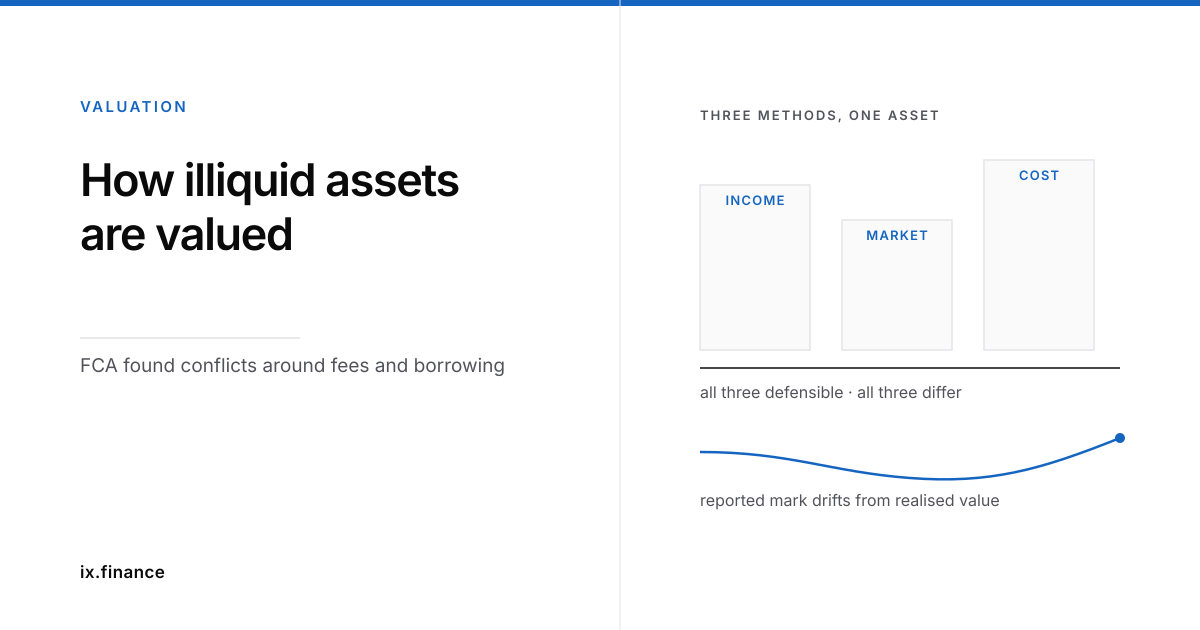 Analysis
How Illiquid Assets Are Valued — and Why the Marks Drift
Illiquid assets have no price, only an estimate. How NAV is built for private assets, why marks lag reality, and what regulators found when they looked.
 Guide
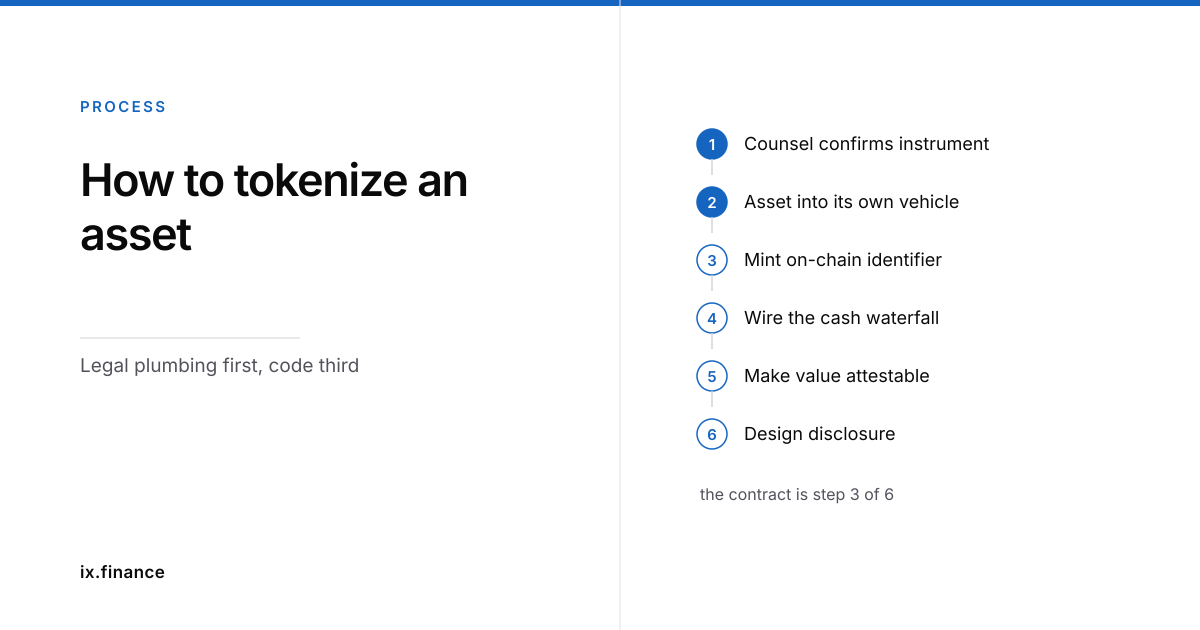
GuideHow to Tokenize an Asset: The Six Steps Nobody Skips
Tokenization is 10% smart contract and 90% legal plumbing. The six steps between a real asset and a claim someone can verify, in the order they must happen.
The register is live.
IX-CORE is the first book on it, running on Base testnet and settling in test tokens. Nothing here is a live financial product.
Open the testnet