How Illiquid Assets Are Valued — and Why the Marks Drift
Illiquid assets have no price, only an estimate. How NAV is built for private assets, why marks lag reality, and what regulators found when they looked.
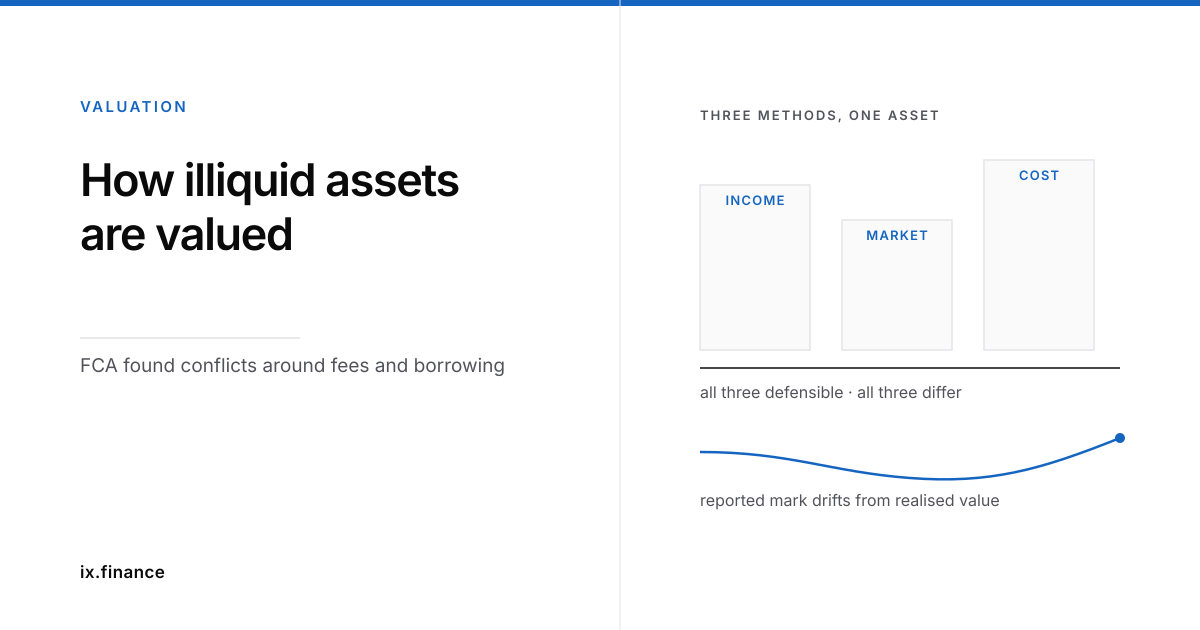
A listed share has a price. An unlisted asset has an opinion.
That is not a criticism — it is arithmetic. Price requires a transaction, and illiquid assets by definition do not transact often. So every quarter, someone estimates what an asset would fetch if it were sold, writes that number down, and everyone downstream treats it as fact.
Fees are charged on it. Redemptions are priced off it. Loans are secured against it. Understanding how that number is built, and how far it can drift, is one of the more useful things an investor in private markets can learn.
Key takeaways
- Illiquid assets are valued by estimate, using income, market comparables or cost methods.
- The FCA found conflicts of interest concentrated around fees, transfers, redemptions and secured borrowing (FCA, Private market valuation practices, March 2025).
- The IMF has named stale and subjective valuations as a structural vulnerability in private credit.
- Research suggests reported NAV compresses dispersion — understating winners and overstating laggards.
Why does an illiquid asset have no price?
Because price is the record of a completed trade, and illiquid assets trade rarely. In the absence of a transaction, valuation substitutes a model for a market. Closed-end private capital alone stands near $16 trillion (McKinsey & Company, Global Private Markets Report 2026, February 2026), and the majority of that value is carried at estimates rather than observed prices.
The estimate is not arbitrary. It follows recognised methods, gets reviewed by committees, and is often checked by third parties. But it remains an estimate produced, in most cases, by the party whose fees depend on it.
Hold that thought. It explains most of what follows.
What are the three ways to value an unlisted asset?
There are three families of method, and the choice among them often matters more than the inputs. Each answers a different question.
| Method | The question it answers | Best for | Weakness |
|---|---|---|---|
| Income | What cash will this produce, discounted to today? | Contracted revenue, infrastructure, loans | Highly sensitive to the discount rate |
| Market | What did similar assets sell for? | Companies with real comparables | Comparables are rarely comparable |
| Cost | What would it cost to replace? | Hardware, early-stage, no revenue | Ignores earning power entirely |
A well-run process triangulates. It runs more than one method, documents why one was weighted more heavily, and keeps the reasoning consistent quarter to quarter.
Here is the part practitioners understate: for the same asset, the three methods can produce values that differ by a wide margin, and all three can be defensible. Method selection is therefore a judgement with financial consequences, which is precisely why governance around it attracts regulatory attention.
Ask any manager which method they use and what the value would be under the other two. A process that can answer immediately is a process that actually runs the comparison. One that treats the question as unusual is telling you something.
Why do marks drift from reality?
Marks drift because they are produced infrequently, with a lag, by an interested party, using inputs that update more slowly than markets do. Private market fund reporting typically arrives months after the period it describes.
The mechanics of drift:
- Reporting lag. Valuations land weeks or months after the quarter end they represent.
- Update frequency. Quarterly marks cannot reflect a market that moved in March.
- Smoothing. Estimates change gradually, so reported volatility is lower than economic volatility.
- Asymmetry. Writing up is easier than writing down, and later.
Academic work on the direction of the bias is pointed. Investments carrying higher reported multiples are more likely to exit above their penultimate valuation, while weaker investments more often exit below it — meaning reported NAV compresses cross-sectional dispersion, understating the upside among winners and overstating the value of laggards. MSCI's research on how buyout marks compare to realised outcomes reaches similar territory.
The practical implication: the average may be roughly right while individual marks are systematically wrong in opposite directions. That is a problem if you are transacting on one asset rather than owning the average.
What did regulators actually find?
They found governance that mostly existed and independence that sometimes did not. The FCA's multi-firm review, published 5 March 2025, covered UK firms managing private equity, venture capital, private debt and infrastructure assets.
Its findings, in brief:
- Nearly all firms had specific valuation governance, and most had valuation committees, which improved independence and oversight.
- Conflicts were most likely around investor fees, asset transfers, redemptions and subscriptions, investor marketing, secured borrowing, and employee remuneration.
- Committee minutes sometimes lacked detail on how valuation decisions were actually reached.
- Practice was inconsistent for ad hoc valuations — the very situations where a fresh mark matters most.
Read that list of conflict areas again. Secured borrowing is on it. When an asset's mark determines how much can be borrowed against it, the incentive to hold that mark up is not theoretical. When a mark sets how much can be borrowed against an asset, the pressure on that mark is structural.
The IMF's assessment of private credit reaches the same place from a systemic angle, naming stale and potentially subjective valuations alongside fragile borrowers and layered leverage. The Financial Stability Board devoted a full report to private credit vulnerabilities in May 2026 (FSB, Report on Vulnerabilities in Private Credit, 6 May 2026).
Can valuation be made verifiable?
Partly — where inputs are observable, the calculation can be made reproducible by anyone. That does not remove judgement, but it moves the argument from the conclusion to the inputs, which is a much better argument to have.
A verifiable valuation needs four properties:
| Property | What it means in practice |
|---|---|
| Observable inputs | Market rates, contracted revenue, depreciation schedules — not internal assumptions |
| Published method | The formula, disclosed, so a third party can recompute it |
| Independent attestation | Inputs signed by parties who do not earn fees on the output |
| Staleness visibility | An old value is flagged as old, not silently trusted |
Assets with contractual revenue and observable market rates are the easiest place to start, which is part of why compute became IX's first book rather than private equity. A cluster has a day-rate you can look up. A private company does not.
Being straight about our own status: IX's compute book derives NAV from live market rates but the oracle is self-attested today, and settlement is in test tokens on Base testnet. Attestor-gated updates are written and not yet enforced. The honest phrasing we hold ourselves to is modeled from live market rates, settled in test tokens — not realised revenue. The full standard is set out in proof of reserve and NAV, and the origin of the cash in who actually pays the yield.
Frequently asked questions
How often should private assets be valued?
Quarterly is the norm, with ad hoc revaluations when something material happens — a funding round, a covenant breach, a comparable transaction. The FCA specifically flagged inconsistency in ad hoc valuations as an area needing improvement.
Does a third-party valuer remove the conflict?
It reduces it. The valuer is still engaged and paid by the manager, and works from information the manager provides. Independence is a matter of degree, and the useful questions are who selected the valuer, who can overrule them, and whether the inputs were verified.
Why do private valuations look less volatile than public markets?
Because infrequent estimation smooths reported values. The underlying economic value moves as much as any comparable public asset; the reporting simply does not capture the path. Treating that smoothness as low risk is a well-documented error.
Is NAV the same as what I would receive if I sold?
Rarely. NAV is an estimate of fair value for a full, orderly disposal. Selling a minority interest quickly usually happens at a discount to NAV — which is why pricing in the secondary market is a better reality check than the manager's own mark.
The short version
Every illiquid asset carries a number that somebody chose. The methods are legitimate, the governance is usually real, and the conflict is structural rather than malicious.
The fix is not more committees. It is inputs anyone can observe, a method anyone can recompute, and signatures from parties who do not profit from the answer.
Related reading: how to tokenize an asset, and what an SPV is.
Sources
- McKinsey & Company, Global Private Markets Report 2026, February 2026, retrieved 2026-08-22 — https://www.mckinsey.com/industries/private-capital/our-insights/global-private-markets-report
- Financial Conduct Authority, Private market valuation practices, 5 March 2025, retrieved 2026-08-22 — https://www.fca.org.uk/publications/multi-firm-reviews/private-market-valuation-practices
- Financial Stability Board, Report on Vulnerabilities in Private Credit, 6 May 2026, retrieved 2026-08-22 — https://www.fsb.org/uploads/P060526.pdf
- MSCI, When Buyout Marks Meet the Market, retrieved 2026-08-22 — https://www.msci.com/research-and-insights/blog-post/when-buyout-marks-meet-the-market
- CFA Institute, Not All NAVs Are Created Equal, retrieved 2026-08-22 — https://rpc.cfainstitute.org/blogs/enterprising-investor/2022/not-all-navs-are-created-equal
Keep reading
All posts →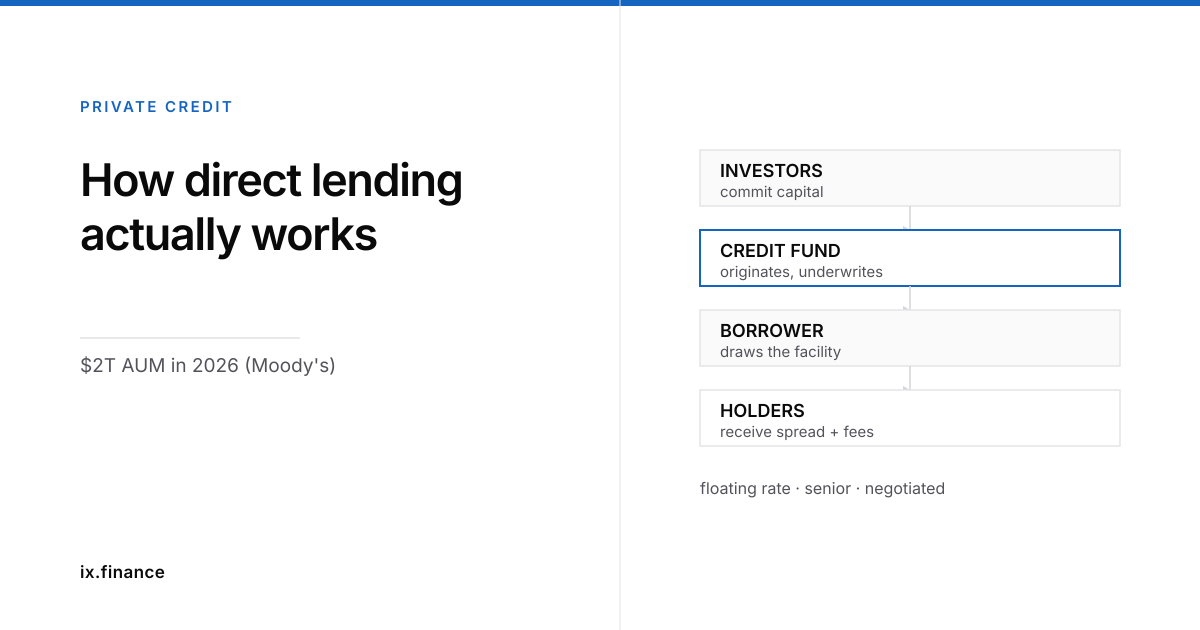 Explainer
Private Credit, Explained: How Direct Lending Actually Works
Private credit AUM passes $2 trillion in 2026. Here is how a direct loan is originated, priced and recovered — and the three risks regulators keep naming.
 Explainer
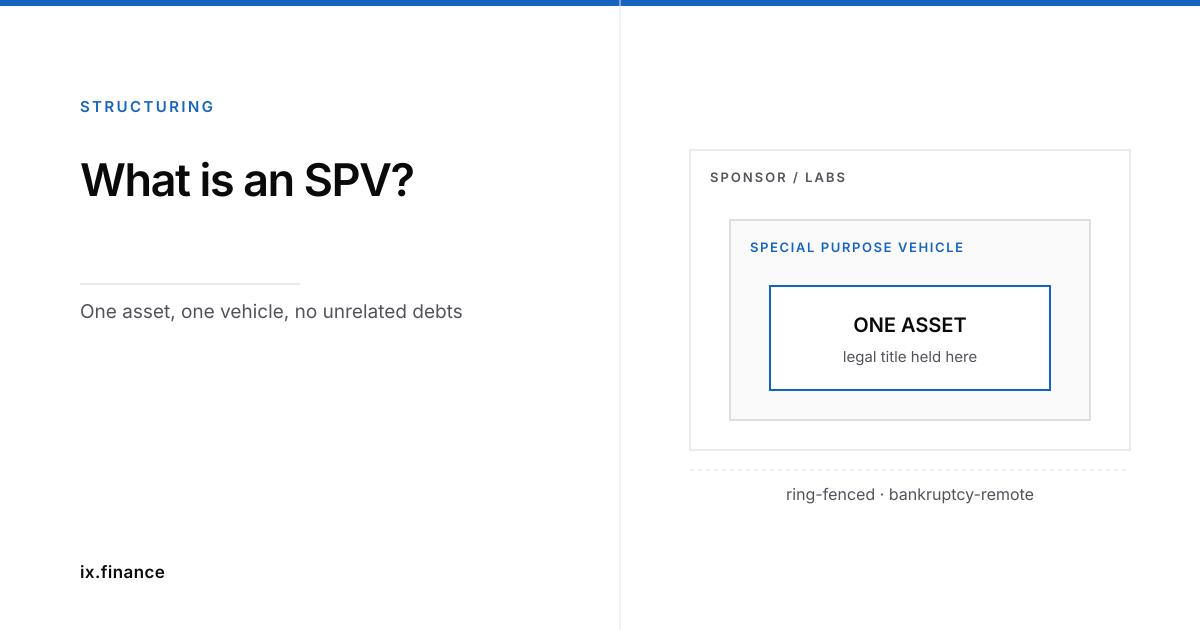
What Is an SPV? Special Purpose Vehicles in Plain English
A special purpose vehicle holds one asset and nothing else. Here is why almost every private deal uses one, what bankruptcy-remote means, and how SPVs fail.
The register is live.
IX-CORE is the first book on it, running on Base testnet and settling in test tokens. Nothing here is a live financial product.
Open the testnet