Zero-Knowledge Proofs in Finance: Proving Without Revealing
A zero-knowledge proof shows a statement is true while revealing nothing else. How solvency, ownership and compliance proofs work — and what they cannot do.
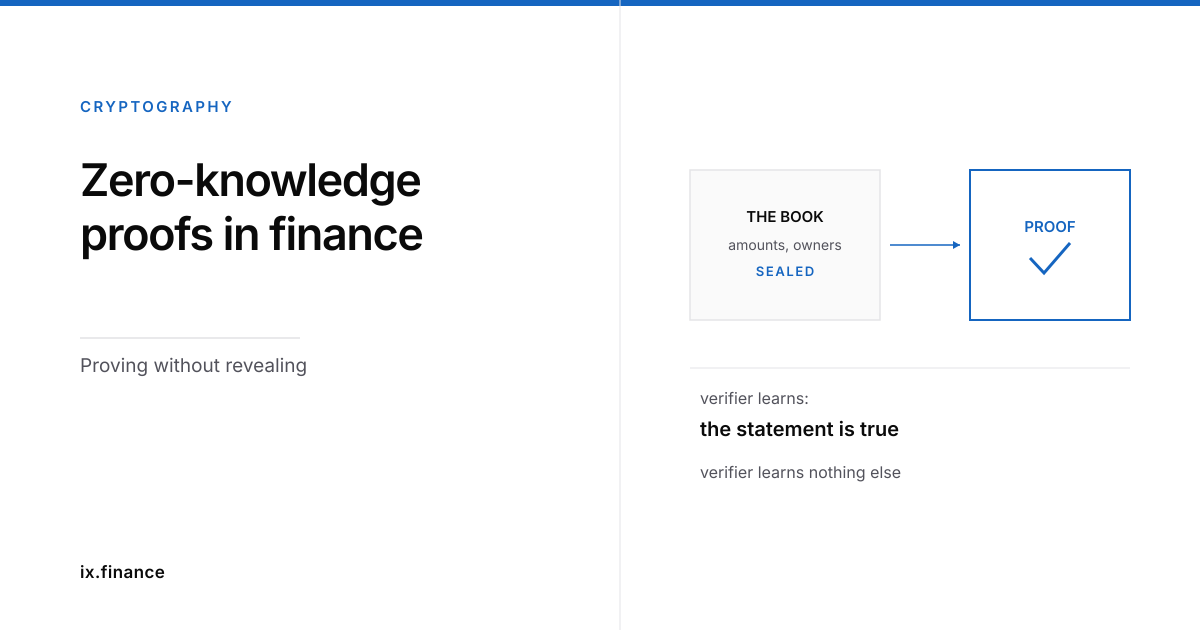
Here's the trick, and it really is as strange as it sounds. You can prove you know a password without saying it. You can prove your reserves exceed your liabilities without disclosing either number. You can prove a balance sits under a limit while keeping the balance private.
Not "hide it and hope." Prove it — mathematically, so that a verifier who trusts nobody can check the claim and learn nothing beyond its truth.
Finance has spent a century solving this with intermediaries. Auditors look at the books and issue an opinion; you trust the auditor. Zero-knowledge proofs offer a different settlement: verify the statement directly, without the data and without the intermediary.
Key takeaways
- A zero-knowledge proof verifies a statement while revealing nothing beyond its truth.
- The three properties are completeness, soundness and zero-knowledge — all three must hold.
- Practical financial uses: solvency proofs, ownership proofs, and compliance attestations.
- Public chains are adding native ZK verification — XRP Ledger integrated a proving network in April 2026 (CoinDesk).
What is a zero-knowledge proof?
It's a protocol where a prover convinces a verifier that a statement is true, without transmitting anything except the proof itself. Three properties have to hold simultaneously, and dropping any one breaks the guarantee.
| Property | What it guarantees |
|---|---|
| Completeness | A true statement can always be proved |
| Soundness | A false statement cannot be proved, except with negligible probability |
| Zero-knowledge | The verifier learns nothing beyond the truth of the statement |
The classic illustration: proving you can tell red from green to someone who is colour-blind, using repeated challenges, without ever naming a colour. Each round halves the chance of a lucky guess. After enough rounds, doubt becomes negligible while no information about the colours has changed hands.
Applied to finance, the statements get more useful and the principle stays identical.
What can it actually prove about money?
Statements about balances, sums and membership — without exposing the values. These are the primitives that matter for a financial book.
- Range. This balance is positive and below a stated limit. Value undisclosed.
- Conservation. Inputs equal outputs in this transfer. Amounts undisclosed.
- Membership. This claim exists in the register. Which claim, undisclosed.
- Non-membership. This counterparty is not in a sanctions set. Identity undisclosed.
- Aggregate solvency. Total reserves minus total liabilities is at least zero. Neither figure disclosed.
That last one is the interesting one for asset registers. A traditional proof of reserves publishes holdings and asks you to trust that liabilities were reported honestly. A cryptographic solvency proof commits to total liabilities in a way that can be verified against reserves, each epoch, without publishing a single balance.
The shift is from "trust the attestation" to "check the proof." An auditor's opinion is a statement about evidence you can't see. A verified proof is a statement you can check yourself with no privileged access at all.
How does this work on a public ledger?
The register stores commitments rather than balances. A commitment is a cryptographic fingerprint of a value — it binds you to that value without revealing it, and it can't be altered after the fact.
The standard construction uses notes rather than accounts:
| Element | What it is | What it reveals |
|---|---|---|
| Note | A holding: value, asset, owner key, randomness | Nothing, held privately |
| Commitment | Hash of the note, published on-chain | Nothing about contents |
| Nullifier | A one-time spend tag derived from the note | Only that some note was spent |
| Proof | Verifies the transfer was valid | Only validity |
A transfer proves membership of the input note in the register, ownership of the spend key, that inputs and outputs balance, that values are in range, and that the nullifier and new commitment are correctly formed. The chain checks the proof and updates the sets. Amounts and owners never appear.
This isn't speculative infrastructure. In April 2026, XRP Ledger integrated Boundless, a zero-knowledge proving network, adding native proof verification so institutions could transact without exposing transaction size, counterparties or treasury positions (CoinDesk, 14 April 2026).
How do auditors and regulators still get access?
Through disclosure keys and targeted proofs, granted deliberately rather than published globally. Confidentiality to the world and disclosure to a supervisor aren't in conflict — they're different permissions on the same record.
Two mechanisms do the work:
- Viewing keys. The holder or issuer hands a key to a named party, who can then read the relevant history. Scope can be limited by asset, period or counterparty.
- Targeted proofs. Rather than granting read access, the prover answers a specific question: is this balance below the threshold, are these the complete holdings, is this address outside the sanctions set.
For supervisors, this can be an improvement on the status quo. Today a regulator asking about private credit exposure gets a manager-prepared spreadsheet. The IMF has named stale and subjective valuations and unclear interlinkages as structural vulnerabilities, and the FSB dedicated a full report to private credit weaknesses in May 2026 (FSB, Report on Vulnerabilities in Private Credit, 6 May 2026). A cryptographically verified answer is stronger evidence than a formatted file.
The direction of travel is toward proofs as evidence — banks attesting to compliance ratios or portfolio risk rather than submitting raw data.
What can zero-knowledge proofs not do?
They can't make a false input true. This is the limitation that matters most, and it's routinely glossed over in marketing.
A proof establishes that a computation was performed correctly on some data. It says nothing about whether that data corresponds to reality. Consider what remains unsolved:
| The proof shows | The proof cannot show |
|---|---|
| Liabilities are covered by committed reserves | That off-chain reserves actually exist |
| The transfer was internally valid | That the asset behind it is real |
| The balance is in range | That the balance was honestly created |
| The register was updated correctly | That the legal title matches the register |
Where reserves sit on-chain, solvency can be proved trustlessly. Where they sit in a bank account or a warehouse, someone must attest that they're there — and that attestor becomes the trust assumption. Staking and slashing can make dishonest attestation expensive. They can't make it impossible.
This is why cryptography doesn't remove the legal work described in how to tokenize an asset. Title in a vehicle, a documented waterfall and attested inputs remain load-bearing. The proof secures the record; it doesn't conjure the asset. The same boundary applies to proof of reserve and NAV.
At IX, this format is specified as IX Cipher. To be exact about where it stands: documentation and specification, no production code, no shielded transfers running. The live compute book uses transparent vault shares on Base testnet with test-token settlement. We'd rather describe the gap than blur it — the reason the format matters is set out in why institutions won't put private assets on a public blockchain.
Frequently asked questions
Are zero-knowledge proofs the same as encryption?
No. Encryption hides data from anyone without the key. A zero-knowledge proof lets someone with no key verify a statement about hidden data. Encryption protects; proofs convince. Confidential systems generally need both.
Do proofs make transactions untraceable?
Not inherently. A well-designed system hides amounts and owners while still publishing nullifiers, so double-spending remains detectable and disclosure remains possible under a viewing key. Auditability is a design choice, and financial systems are built to keep it.
Is this fast enough for real use?
For registers and periodic solvency proofs, yes — the workload is modest and verification is cheap. High-frequency trading is a harder target. Proving costs have fallen sharply and public chains are adding native verification, which shifts the constraint from performance to whether a proof is accepted as evidence.
Could a bug undermine a proof?
Yes, and this is the practical risk. A flawed circuit can make false statements provable, and such bugs are subtle. Audited implementations, formal verification and conservative deployment matter more than proving speed. Any system claiming certainty from cryptography alone is overclaiming.
The short version
Zero-knowledge proofs collapse a trade-off finance has treated as permanent: you can keep a book confidential and still let anyone verify the properties that matter.
What they don't do is make an unreal asset real. Cryptography secures the record. Legal title, attested inputs and a documented waterfall still have to be there.
Related reading: how illiquid assets are valued, and what an SPV is.
Sources
- CoinDesk, XRP Ledger adds zero-knowledge proofs targeting institutional privacy gap, 14 April 2026, retrieved 2026-08-24 — https://www.coindesk.com/tech/2026/04/14/xrp-ledger-adds-zero-knowledge-proofs-targeting-institutional-privacy-gap
- Financial Stability Board, Report on Vulnerabilities in Private Credit, 6 May 2026, retrieved 2026-08-24 — https://www.fsb.org/uploads/P060526.pdf
- Nethermind, Zero-Knowledge Proofs in Blockchain Finance: Opportunity vs. Reality, retrieved 2026-08-24 — https://www.nethermind.io/blog/zero-knowledge-proofs-in-blockchain-finance-opportunity-vs-reality
Keep reading
All posts →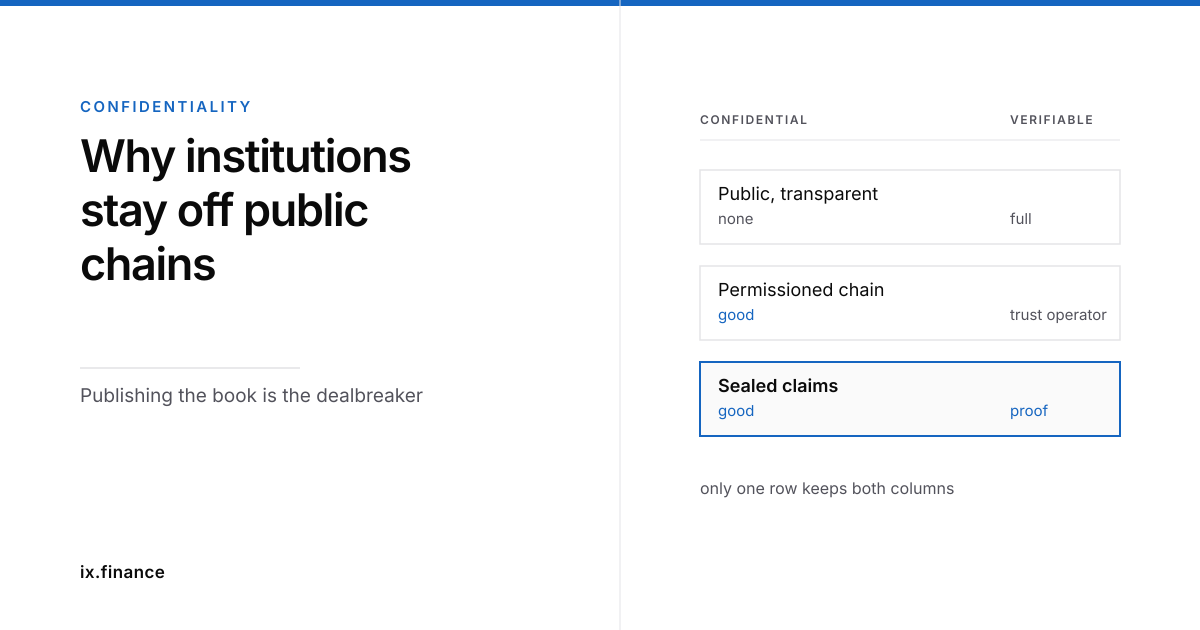 Analysis
Why Institutions Won't Put Private Assets on a Public Blockchain
A public ledger publishes your book to competitors. That single fact explains why $25 trillion of private capital has stayed off-chain while Treasuries moved.
 Guide
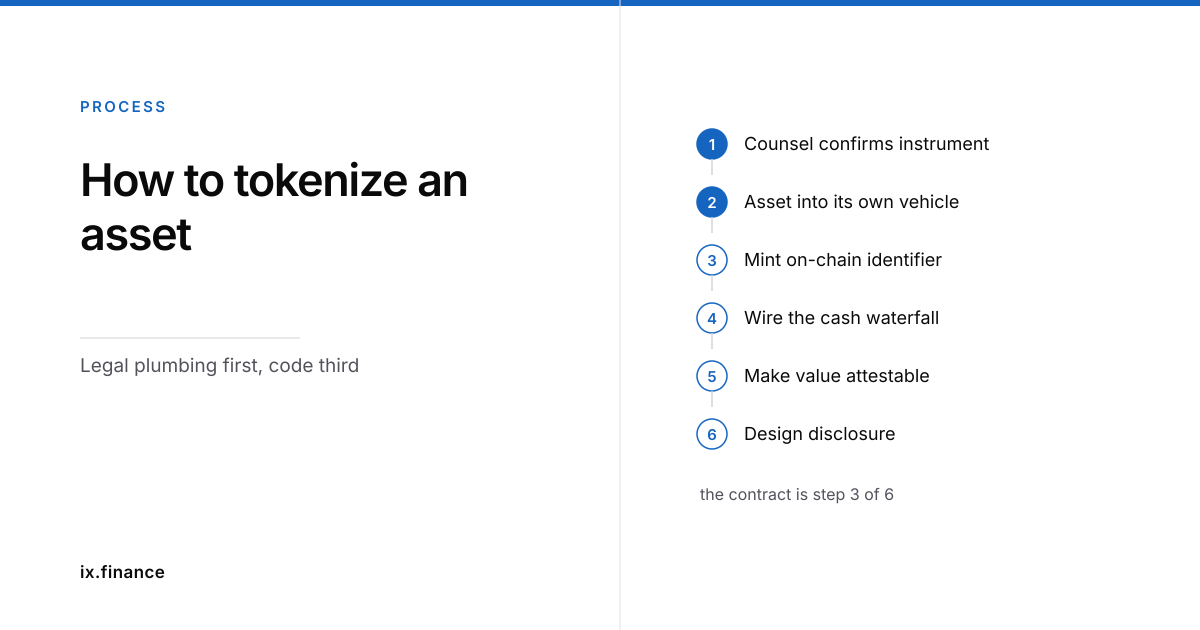
GuideHow to Tokenize an Asset: The Six Steps Nobody Skips
Tokenization is 10% smart contract and 90% legal plumbing. The six steps between a real asset and a claim someone can verify, in the order they must happen.
The register is live.
IX-CORE is the first book on it, running on Base testnet and settling in test tokens. Nothing here is a live financial product.
Open the testnet